
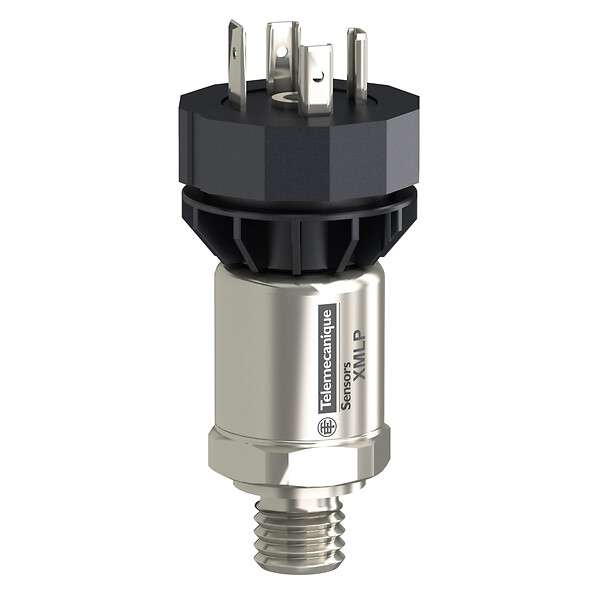
Telemecanique XMLPM01GC21F Pressure Transmitter: -1…1 bar Measurement with 4–20 mA 2-Wire Control Integration
Vacuum-to-low-pressure measurement sits at the center of many industrial processes: pneumatic circuits, vacuum gripping, filtration monitoring, and low-pressure water and gas lines. In these applications, stability matters more than headline range. The Telemecanique XMLPM01GC21F pressure transmitter is specified for a -1…1 bar class window and provides a 4–20 mA 2-wire analog output designed for robust PLC integration over long cable runs and noisy environments.
This technical article explains what the Telemecanique XMLPM01GC21F pressure transmitter is, which specifications define its operating envelope, and how to apply implementation governance so that measured values remain consistent after maintenance, replacement, or line upgrades.
Technical Identity: What the Device Is
The product data sheet describes the Telemecanique XMLPM01GC21F pressure transmitter as an electronic pressure transmitter in the Telemecanique Pressure sensors XM range with a pressure rating of -1…1 bar. It is specified with an analogue output 4…20 mA, 2-wire, a G 1/4A male fluid connection (DIN 3852-E), and a male connector EN 175301-803-A (ex DIN43650), 3 pins.
- Pressure rating: -1…1 bar ([downloads.telemecaniquesensors.com]
- Output: 4…20 mA, 2-wire
- Supply: 12…24 V DC SELV (limits 7…33 V)
- Response time: ≤ 2 ms (10…90% FS)
- Accuracy: ±0.5% of measuring range
- IP protection: IP65
From an engineering perspective, the key message is simple: the Telemecanique XMLPM01GC21F pressure transmitter is not a “generic pressure sensor.” It is a bounded -1…1 bar instrument with a standardized current loop output that is designed for control-grade signaling and repeatable scaling.
Why 4–20 mA 2-Wire Matters in Real Plants
A 4–20 mA current loop is widely used because it tolerates electrical noise and voltage drop better than many voltage outputs. In practice, this supports predictable readings across longer cable routes and crowded cable trays. The device’s 2-wire technique and 4–20 mA output are explicitly documented in the wiring diagram section.
For the Telemecanique XMLPM01GC21F pressure transmitter, stable scaling is the governance requirement. A typical control standard maps:
- 4 mA = -1 bar
- 20 mA = +1 bar
The exact mapping must follow your instrumentation standard, but the most important operational point is consistency: document the mapping, keep it unchanged across program revisions, and store it in maintenance records so a replacement unit is commissioned without interpretation drift.
Application Fit: Fluids and Temperature Envelope
The data sheet lists controlled fluids and temperatures that provide practical guidance for where the device can be deployed. It references fresh water (0…125°C), air, gas, and hydraulic oil (-15…125°C). This matters because many low-pressure use cases are in pneumatics and utility lines where temperature can swing significantly across seasons or machine warm-up states.
Materials in contact with fluid are also specified (ceramic, stainless steel AISI 316L, and FPM). From a reliability standpoint, matching materials to your media reduces long-term drift and prevents premature sealing issues.
Installation Governance: Mechanical and Electrical Discipline
In low-pressure measurement, installation effects can dominate the signal. If the transmitter is installed where turbulence, pulsation, or rapid valve switching creates spikes, the reading can look unstable even when the sensor is correct. A disciplined approach includes:
- Choosing a measurement tap that represents the controlled reality (not a transient pocket).
- Ensuring proper sealing on the G 1/4A male connection to prevent micro-leaks.
- Routing the cable to reduce vibration stress at the DIN connector interface.
When commissioning, validate response behavior against a known reference. The response time (≤2 ms) allows fast detection of pressure changes, but it also means transients will be visible. If transients should not trigger alarms, handle that governance in PLC filtering and alarm strategy rather than assuming the instrument will “smooth it out.”
For broader sensor ecosystem guidance, see Telemecanique sensor.
FAQ
- What is the pressure rating of the Telemecanique XMLPM01GC21F pressure transmitter?
It is specified as -1…1 bar. - What output signal does it provide?
It provides 4…20 mA analogue output, 2-wire technique. - What is the process connection type?
G 1/4A (male) conforming to DIN 3852-E. - What is the response time?
Response time on output is ≤ 2 ms (10…90% full scale). - What is a common commissioning mistake?
Incorrect PLC scaling of 4–20 mA, causing shifted vacuum/pressure thresholds and false alarms.
With defined scaling, disciplined installation, and documented alarm governance, the Telemecanique XMLPM01GC21F pressure transmitter becomes a dependable -1…1 bar measurement element for industrial control systems.