
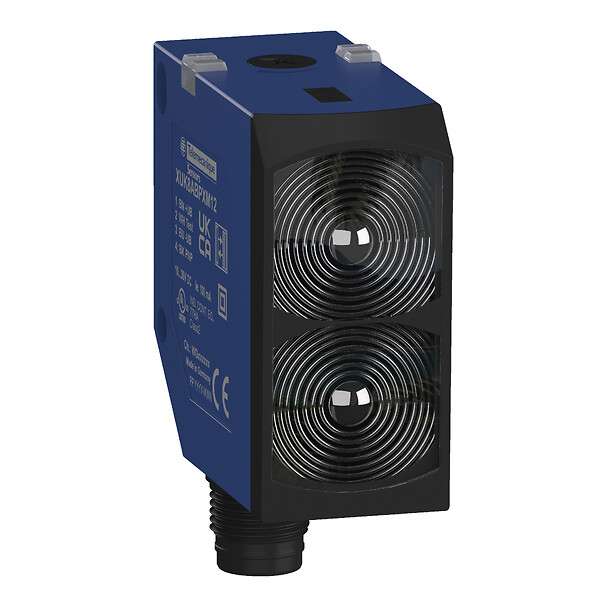
Telemecanique XUB8BPXNM12 Photoelectric Sensor: Diffuse Background Suppression for Clean 0.3 m Detection
Presence detection becomes complicated when the background is “too visible.” In many machines, the product passes in front of a shiny guard, a reflective chute, or a close backplate. A conventional diffuse sensor may see both the target and the background, leading to unstable switching. This is where background suppression (BGS) matters: it is designed to reduce background influence and keep detection focused on the intended zone. The Telemecanique XUB8BPXNM12 photoelectric sensor is specified as a diffuse BGS sensor in a rugged cylindrical metal format, built for repeatable detection in compact automation zones.
This guide explains the specification set of the Telemecanique XUB8BPXNM12 photoelectric sensor, why BGS improves operational stability, and how to integrate and commission the sensor so the detection window remains consistent across production changes.
Technical Identity and Core Specifications
The product datasheet lists the Telemecanique XUB8BPXNM12 photoelectric sensor as a photoelectric sensor in the XU range with a cylindrical M18 metal design and a diffuse with background suppression detection system. It is specified with Smax 0.3 m, PNP discrete output, and an M12 4-pin male connector.
- Sensor design: Cylindrical M18
- Detection system: Diffuse with background suppression
- Nominal sensing distance: 0.3 m (diffuse BGS)
- Discrete output type: PNP
- Output function: 1 NO or 1 NC programmable
- Electrical connection: 1 male connector M12, 4 pins
- Emission: Red LED diffuse with background suppression
- Switching frequency: 1000 Hz
- Protection rating: IP65, IP67, IP69K
Why Background Suppression Reduces False Switching
BGS is valuable when the background is close to the target or highly reflective. Instead of relying only on “how much light returns,” the sensing behavior is tuned so the sensor is less likely to treat distant background reflections as a valid target. In practical terms, that improves stability when product height varies, when the line has mixed packaging finishes, or when guards are polished stainless.
With a 0.3 m nominal sensing distance, the Telemecanique XUB8BPXNM12 photoelectric sensor is often chosen for short-range detection windows where you want a clear cutoff between the intended target zone and the background structure.
PLC Integration: PNP Output and Programmable NO/NC
The sensor is specified with PNP output and NO/NC programmable function. The governance task is to define your signal semantics and keep them consistent across assets:
- Decide whether input ON should mean “target present” or “target absent.”
- Choose NO or NC consistently and document the rationale.
- Align any PLC input filtering with the switching frequency and response expectations to avoid missing short events.
The M12 4-pin connector supports modular maintenance. In uptime-focused lines, that matters because replacement becomes a controlled action rather than field rewiring.
Commissioning: Set the Window, Then Validate the Worst Case
The datasheet states sensitivity setting by potentiometer. A practical commissioning workflow is:
- Mount the sensor rigidly and define the intended sensing distance within the 0.3 m class zone.
- Adjust sensitivity so the real target is detected reliably while the background remains ignored.
- Validate using the darkest and least reflective product variant, plus a “no product” condition.
Background suppression reduces risk, but it is not magic. If the target is too small, too angled, or outside the stable geometry, any diffuse method can become marginal. That is why validating worst-case conditions is more valuable than confirming only ideal conditions.
For broader selection conventions and related sensor ecosystem content, see Telemecanique sensor.
FAQ
- What detection system is used by the Telemecanique XUB8BPXNM12 photoelectric sensor?
It is specified as diffuse with background suppression. - What is the nominal sensing distance?
The datasheet lists 0.3 m (diffuse BGS). - What output type is provided?
It is specified with PNP output and NO/NC programmable function. - Which connector is used?
It uses a male M12 connector with 4 pins. - What is a common root cause of unstable detection?
Operating at the edge of the detection window without validating worst-case targets and background reflectivity.
When the detection zone is engineered and commissioning is validated against worst-case conditions, the Telemecanique XUB8BPXNM12 photoelectric sensor delivers stable short-range presence detection with reduced background influence.