
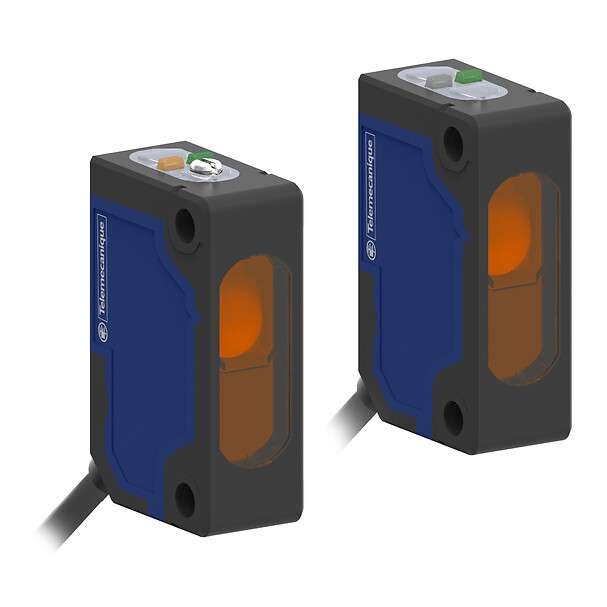
Telemecanique XUM2ANXBL2 Miniature Through-Beam Photoelectric Sensor: Long Smax 30 m Detection in a Compact System
In automation programs where uptime is measured in minutes, the sensing layer must be predictable. A frequent root cause of “random” stops is not the PLC logic but marginal optical sensing—especially when targets vary in color or surface finish. A through-beam architecture reduces that risk by defining detection as a beam interruption rather than reflected light intensity. The Telemecanique XUM2ANXBL2 miniature through-beam photoelectric sensor is engineered for that exact objective: stable detection with a compact footprint and a system-style transmitter/receiver design.
This article documents what the Telemecanique XUM2ANXBL2 miniature through-beam photoelectric sensor is, how its electrical and timing characteristics influence integration, and which installation practices protect long-term performance. The focus is informational and implementation-oriented, with practical guidance aligned to industrial maintenance realities.
Product Identity and Technical Profile
The Telemecanique XUM2ANXBL2 miniature through-beam photoelectric sensor is specified as a miniature through-beam sensor system with Smax = 30 m, NPN discrete output, and a 2 m cable. This positioning is explicitly stated on the manufacturer reference page. (https://telemecaniquesensors.com/global/en/product/reference/XUM2ANXBL2)
- Detection system: through-beam
- Output type: discrete, NPN
- Output function: 1 NO or 1 NC programmable
- Supply: 12…24 V DC with reverse polarity protection
- Switching frequency: 1000 Hz
- Delay response / recovery: 0.5 ms / 0.5 ms
- Current consumption: 20 mA transmitter, 20 mA receiver
- Protection: IP65, IP67
These parameters define where the Telemecanique XUM2ANXBL2 miniature through-beam photoelectric sensor fits best: medium-to-long optical corridors where stable detection matters more than surface reflectivity. The 1000 Hz switching frequency and sub-millisecond timing support fast, repeatable events on conveyors and assembly stations without forcing the PLC to over-sample the input.
Why Through-Beam Stabilizes Detection
Diffuse and reflex methods can be sensitive to target color, texture, and ambient reflections. Through-beam sensing is different: the receiver expects a known signal from the transmitter, and detection is a clean interruption event. That makes the Telemecanique XUM2ANXBL2 miniature through-beam photoelectric sensor a strong candidate for mixed product portfolios where one line might run dark polymer parts in the morning and bright cartons in the afternoon.
When engineered correctly, the optical corridor becomes a governed control asset rather than a “best effort” signal. The practical outcome is fewer intermittent faults and faster recovery after maintenance work.
Electrical Integration: NPN Governance and PLC Inputs
The device is specified as NPN with programmable NO/NC function. In operational terms, this means your input wiring philosophy must be consistent. The common failure pattern is not incorrect wiring, but inconsistent conventions: one machine defines input ON as “beam made,” another defines it as “beam blocked.” Both can work, but mixing conventions increases diagnosis time during downtime.
For a governed integration, document:
- Signal meaning (beam made vs beam interrupted).
- Configured output function (NO or NC) and the reason.
- Expected timing (0.5 ms response) so filtering choices do not suppress real events.
Mechanical Integration: Corridor Design and Alignment
Because Smax is specified up to 30 m, it is tempting to operate near the maximum distance. In practice, the reliability strategy is to keep margin: operate well inside the stable corridor so dust, vibration, and bracket drift do not convert a stable signal into a marginal one. Use rigid mounting for both transmitter and receiver, and protect the beam path from cable loops or guard edges that can partially obscure the line-of-sight.
Environmental robustness is supported by IP65/IP67 protection. Still, sealing depends on installation discipline: strain relief and controlled cable routing reduce the chance of micro-movement that can translate into alignment drift over time.
Operational Maintenance: Make Replacement Predictable
Miniature sensors perform best when treated as standardized modules. Record the bracket reference points, the approximate corridor distance, and the PLC channel mapping. That way, if a sensor is replaced, the restored position and logic are repeatable rather than “trial-and-error.”
For additional ecosystem conventions and selection references, use this internal resource: Telemecanique sensor.
FAQ
- What is the Telemecanique XUM2ANXBL2 miniature through-beam photoelectric sensor?
It is a miniature through-beam photoelectric sensor system with NPN output and 2 m cable. - What is the maximum sensing distance?
The reference specifies Smax = 30 m. - What supply voltage is used?
It is specified for 12…24 V DC with reverse polarity protection. - How fast can it switch?
The switching frequency is specified as 1000 Hz, with 0.5 ms response/recovery. - What is a common cause of intermittent detection?
Marginal alignment due to flexible brackets or partial beam obstruction by cable routing or guards.
When corridor margin, alignment governance, and PLC conventions are documented, the Telemecanique XUM2ANXBL2 miniature through-beam photoelectric sensor delivers stable long-distance presence detection in compact automation architectures.