
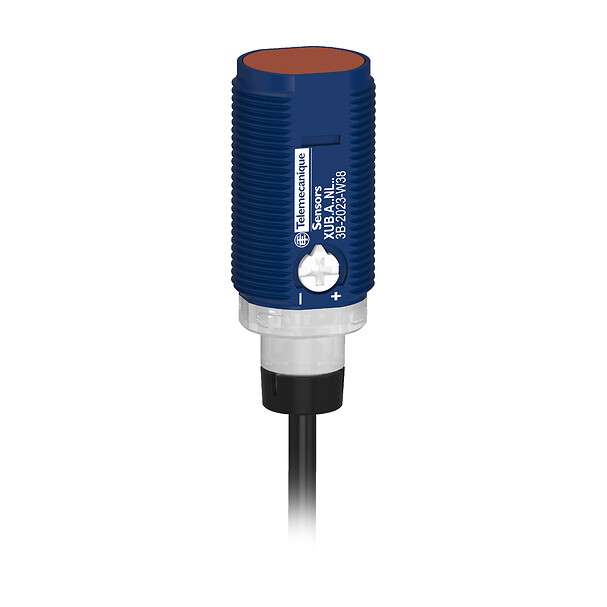
Telemecanique XUN5APXNL2 Photoelectric Sensor: Hybrid Diffuse Long for 1 m Class Detection
Eliminating reflectors is attractive in production lines because it reduces mechanical parts and simplifies spares management. However, long diffuse sensing places greater demands on installation discipline because reflectivity and background geometry become more influential. The Telemecanique XUN5APXNL2 photoelectric sensor is specified as a hybrid diffuse long model positioned for a 1 m class distance category, supporting robust presence detection when the sensing corridor is engineered properly.
This guide explains the technical identity of the Telemecanique XUN5APXNL2 photoelectric sensor, how hybrid diffuse long behavior impacts applications, and how to integrate the sensor into PLC logic without creating nuisance stops.
Detection Method: Hybrid Diffuse Long
The Telemecanique XUN5APXNL2 photoelectric sensor is referenced as a hybrid proximity long sensor in distributor listings, with Sn 1 m class and PNP output, commonly listed with NO/NC switching and a 2 m cable.
Diffuse long sensing detects reflected light from the target, so the “effective range” depends on material. Dark targets can reduce practical margin, while bright surfaces can extend it. That is why commissioning should validate the worst-case target rather than the easiest one.
Core Technical Characteristics
- Technology: hybrid diffuse long photoelectric sensor
- Distance class: Sn 1 m class referenced in listings
- Output: PNP, NO/NC referenced in listings
- Cable: 2 m cable referenced in listings
These characteristics position the Telemecanique XUN5APXNL2 photoelectric sensor for packaging transfers, conveyor presence checks, and assembly confirmation where a reflector is inconvenient or where mechanical access for reflectors is limited.
Installation Discipline: The Difference Between “Works” and “Stays Working”
At longer diffuse distances, stability is governed by three variables:
- Distance margin: avoid operating at the maximum limit; keep buffer for contamination and drift.
- Background control: prevent reflective guards from acting as unintended targets.
- Mechanical rigidity: bracket drift can move the sensor from stable to marginal behavior.
For the Telemecanique XUN5APXNL2 photoelectric sensor, a professional practice is to validate detection at the farthest planned distance using the darkest product variant. If that scenario is stable, the easier variants will typically remain stable as well.
PLC Logic: NO/NC Governance and Operational Clarity
Because listings reference NO/NC switching, teams often choose the function that best fits the fault philosophy. For example:
- NC logic can support fault visibility if a broken wire is interpreted as a fault state.
- NO logic can be simpler when inputs represent “presence true” events.
Whichever approach is chosen, document it clearly. The biggest operational risk is mixing conventions across stations, which forces technicians to “guess” signal meaning during downtime.
Application Fit
- Conveyor transfer confirmation where targets pass within a controlled corridor.
- Packaging machine checks where a reflector would be vulnerable to impact.
- Assembly station presence detection with moderate distances and limited mounting space.
For additional ecosystem alignment and selection patterns, see Telemecanique sensor.
FAQ
- What sensing method is used by the Telemecanique XUN5APXNL2 photoelectric sensor?
It is referenced as a hybrid proximity long (diffuse long) photoelectric sensor. - What is the distance class?
Sn 1 m class is referenced in distributor listings. - What output type is referenced?
PNP output with NO/NC references is listed. - What cable length is referenced?
A 2 m cable is referenced in listings. - What typically causes instability?
Operating too close to the range limit, reflective backgrounds, and bracket movement under vibration.
When distance margin is engineered and logic conventions are standardized, the Telemecanique XUN5APXNL2 photoelectric sensor provides reliable hybrid diffuse long detection for industrial automation.