
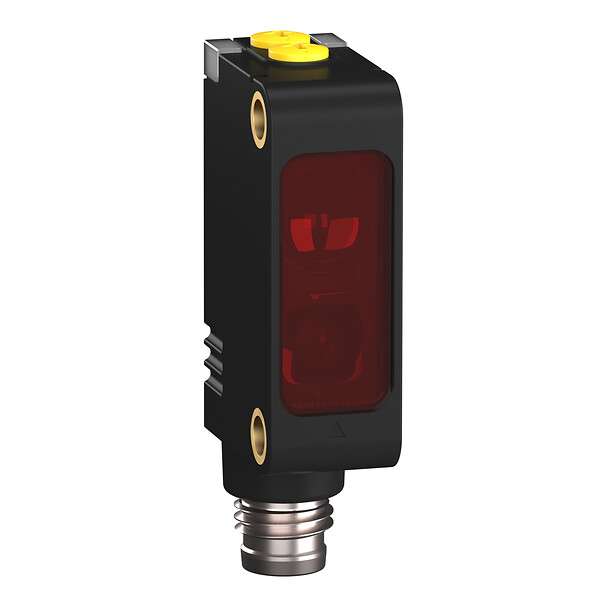
Telemecanique XUM8PLPXM8 Laser Photoelectric Sensor: Fast, Compact Detection in the 30–200 mm Zone
Short-range detection can become unexpectedly complex when targets vary in surface finish, when parts are small, or when space constraints force tight mounting angles. A laser-based photoelectric sensor can deliver sharper spot control and improved repeatability in compact stations—especially when cycle time is high. The Telemecanique XUM8PLPXM8 laser photoelectric sensor is engineered as a miniature “smart detector” with a Class 1 red laser source and fast switching performance intended for industrial automation.
This technical article explains the key specifications of the Telemecanique XUM8PLPXM8 laser photoelectric sensor, how to design the sensing geometry for stability, and how to integrate it into PLC-based systems with predictable commissioning.
Laser Emission and Safety Context
The Telemecanique XUM8PLPXM8 laser photoelectric sensor uses a Class 1 laser light source with 650 nm red emission. Class 1 classification supports routine industrial deployment without special laser safety controls beyond standard good practice, while still benefiting from a focused beam profile.
Core Technical Characteristics
- Supply: 10…30 VDC (including ripple p-p 10% max).
- Emission: Class 1 laser, 650 nm (red).
- Response time: 0.25 ms.
- Switching frequency: 2 kHz.
- Indicators: output status (yellow), stability (green).
- Protection: IP65 / IP67.
- Connection: M8 connector, 4 pins.
- Operating distance examples (datasheet): 30–200 mm (W/B <25%), 30–130 mm (Black 6%), up to 10–500 mm (White 90%).
These points define why the Telemecanique XUM8PLPXM8 laser photoelectric sensor is frequently selected for fast, short-range applications. The 2 kHz switching frequency and sub-millisecond response time support high-cycle stations where a standard diffuse sensor could become a limiting factor.
Designing the Sensing Geometry for Stability
Laser sensors still require disciplined geometry. A stable installation strategy for the Telemecanique XUM8PLPXM8 laser photoelectric sensor includes:
- Controlled distance: keep the target within a proven operating zone for the material class (dark vs. white surfaces).
- Rigid bracket: even minor vibration can shift the beam spot on small parts.
- Background control: prevent the beam from intersecting glossy metal guards that can reflect light back into the receiver.
The device includes stability indication via LED, which is useful during commissioning: you can verify that the sensor sees a clean signal margin rather than simply seeing the output toggle.
Electrical Integration: M8 Connector and PLC Inputs
The M8 4-pin interface of the Telemecanique XUM8PLPXM8 laser photoelectric sensor supports modular replacement and standardized cordsets. Standardization matters: it reduces wiring errors and enables a clean spare strategy across a fleet of similar machines.
Because switching is fast, PLC scan time and input filtering should be aligned to the real cycle. Overly aggressive filtering can hide legitimate short events, while no filtering can expose noise if the cable route crosses high-current lines. The right balance is validated during commissioning by observing event repeatability at production speed.
Where This Sensor Fits Best
- Compact assembly fixtures with small parts and tight detection windows.
- High-speed packaging stations where fast response reduces missed detections.
- Quality checks requiring repeatable spot placement on the target.
For broader ecosystem guidance and compatible components, reference Telemecanique sensor resources.
FAQ
- What type of light source does the Telemecanique XUM8PLPXM8 laser photoelectric sensor use?
It uses a Class 1 red laser source at 650 nm. - How fast is the switching?
The datasheet lists 0.25 ms response time and 2 kHz switching frequency. - What connector is used?
It uses an M8 4-pin connector. - What protection rating is referenced?
IP65 and IP67 are referenced. - What causes most false triggers in short-range laser sensing?
Uncontrolled reflections from glossy backgrounds and bracket drift that moves the beam spot off the intended target zone.
When distance, bracket rigidity, and background geometry are engineered deliberately, the Telemecanique XUM8PLPXM8 laser photoelectric sensor delivers fast, repeatable detection that scales well across high-cycle automation stations.