
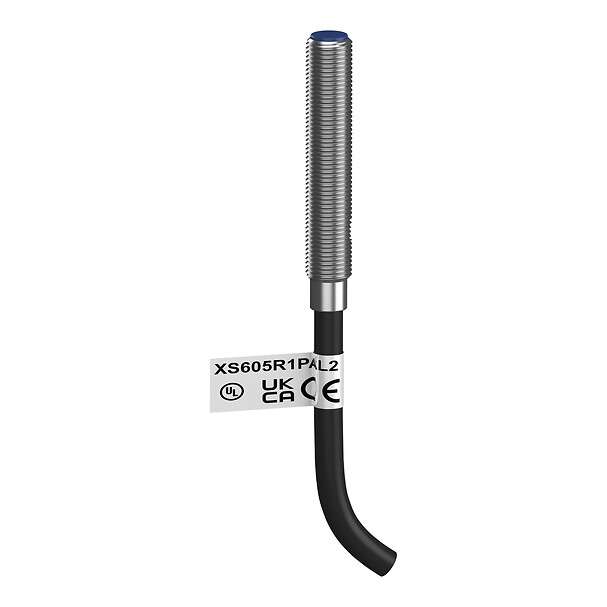
Telemecanique XS605R1PAL2 Inductive Sensor: Miniature M5 Metal Detection for Compact Mechanisms
When automation systems become smaller and more modular, sensing points must fit into increasingly tight mechanical envelopes. In these contexts, inductive proximity sensors are valued because they detect metal targets without contact and without sensitivity to lighting, dust, or oil mist. The Telemecanique XS605R1PAL2 inductive sensor is specified as a miniature M5-format sensor designed for close-range metal detection where space is limited and reliability must remain high.
This technical guide explains how the Telemecanique XS605R1PAL2 inductive sensor is specified and how to integrate it into PLC logic while keeping the mechanical and electrical design predictable under real production conditions.
Detection Principle: Inductive Proximity
Inductive sensors generate an electromagnetic field and detect changes when a metal target enters the sensing zone. This provides stable detection that is largely immune to dust, ambient light, and typical surface contamination. The tradeoff is distance: inductive sensors operate at short range compared to optical methods, but deliver excellent repeatability in close-range metallic detection.
Core Technical Characteristics
- Sensor technology: inductive proximity sensor, miniature format.
- Body format: cylindrical M5 threaded barrel, stainless steel housing.
- Nominal sensing distance class: Sn 1.5 mm is referenced in product descriptions; some distributor listings reference up to 2.5 mm depending on conditions and target.
- Output: PNP discrete switching, NO function, 3-wire.
- Connection: pre-cabled, typically 2 m cable length in listings.
These characteristics make the Telemecanique XS605R1PAL2 inductive sensor suitable for fine-position confirmation, small-part presence checks, and compact end-stop detection where the target is metallic and reliably positioned within a narrow sensing window.
Mechanical Integration: The Real Success Factor
With miniature inductive sensors, mechanical alignment governs performance. For stable operation with the Telemecanique XS605R1PAL2 inductive sensor:
- Design a controlled target approach path so the metal enters the sensing zone consistently.
- Prevent vibration-induced drift by using a rigid bracket and locking fasteners after alignment.
- Avoid side-loading the sensor body when tightening into thin plates; use proper mounting hardware.
Because the sensing distance is short, small changes in bracket position can appear as “electrical issues” even when wiring is correct. Documenting the set distance and target geometry during commissioning is therefore a high-value practice.
Electrical Integration: PNP NO Output Governance
The Telemecanique XS605R1PAL2 inductive sensor uses a PNP NO discrete output, which typically interfaces cleanly to PLC digital inputs. A disciplined approach is to define input filtering and debounce only when required. Over-filtering can mask legitimate short events, while under-filtering can expose bounce in mechanically noisy zones.
Use consistent labeling at termination points. In compact machines, the time saved during troubleshooting is often more valuable than the material cost of labeling.
Common Application Fit
- Metal tab detection in packaging and labeling mechanisms.
- Fixture confirmation for assembly jigs with metal reference pins.
- End-of-stroke sensing where a metallic carriage reaches a defined point.
For broader sensor ecosystem alignment and accessory conventions, see Telemecanique sensor references.
FAQ
- What does the Telemecanique XS605R1PAL2 inductive sensor detect?
It detects metallic objects using inductive proximity technology. - What is the typical sensing distance?
Datasheet/product descriptions commonly reference Sn 1.5 mm; some listings cite higher ranges depending on conditions. - What is the output type?
PNP discrete switching with NO function is referenced. - Why choose an M5 miniature sensor?
It fits tight mechanisms where larger barrel sizes cannot be mounted without redesign. - What is the most common cause of “random” switching?
Mechanical drift that moves the target slightly out of the short sensing window.
When the target geometry is controlled and mounting is rigid, the Telemecanique XS605R1PAL2 inductive sensor delivers stable miniature metal detection with maintainable wiring conventions.