
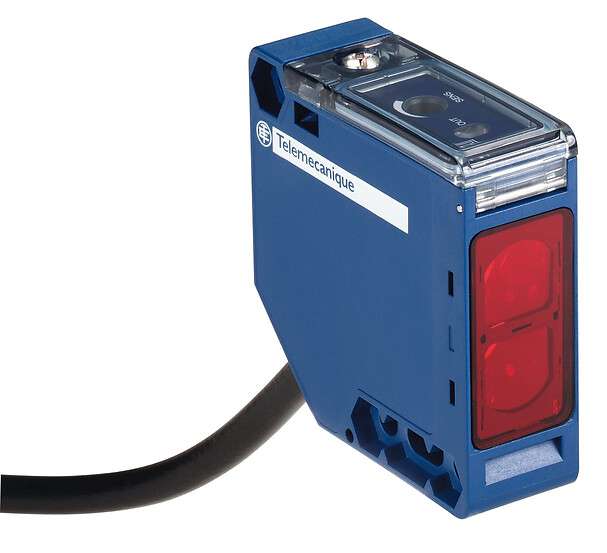
Telemecanique XUK1ARCNL2-SM-07 Photoelectric Sensor: Reflex Detection up to 7 m on AC/DC Supply
Production lines often need a detection method that is both non-contact and operationally tolerant—capable of working across shift changes, cleaning cycles, and mechanical vibration without constant recalibration. The Telemecanique XUK1ARCNL2-SM-07 photoelectric sensor is a reflex (retro-reflective) photoelectric unit in the XU family designed for general purpose single-mode deployments where an AC/DC supply and relay-style switching are preferred.
This article explains how the Telemecanique XUK1ARCNL2-SM-07 photoelectric sensor is specified, what the reflex system implies for installation design, and how to implement it as a stable, auditable detection layer in industrial automation.
Technology Summary: Reflex Detection in Practical Terms
A reflex sensor emits a beam toward a reflector and detects the returned light. In day-to-day operations, this creates a convenient architecture: you mount a single sensor on one side of the conveyor or machine zone and a reflector on the opposite side. When a product blocks the beam, the sensor changes state. The Telemecanique XUK1ARCNL2-SM-07 photoelectric sensor is specified as reflex with an infrared emission profile and a nominal sensing distance of 7 m (with an appropriate reflector reference).
Core Technical Characteristics
- Detection system: Reflex.
- Nominal sensing distance: Sn 7 m (reflex, reflector required).
- Maximum sensing distance (datasheet class): 10 m reflex.
- Supply circuit type: AC/DC.
- Rated supply voltage: 24…240 V AC/DC (with stated limits for AC).
- Output signal: Discrete; output type: relay.
- Wiring technique: 5-wire.
- Electrical connection: cable; cable length 2 m.
- Mechanical format: compact 50 × 50 design class.
These specifications make the Telemecanique XUK1ARCNL2-SM-07 photoelectric sensor particularly relevant in mixed-voltage environments and retrofit contexts where AC/DC supply convenience and relay switching behavior simplify integration into existing panels.
Installation Design: Reflector, Alignment, and False Trigger Control
The reflex method is operationally efficient, but stability is defined by mechanical discipline. A practical setup approach for the Telemecanique XUK1ARCNL2-SM-07 photoelectric sensor includes:
- Rigid reflector mounting: Avoid flexible brackets; vibration changes the beam return path.
- Controlled line-of-sight: Keep the beam corridor free of guard reflections and glossy surfaces that can mimic a reflector return.
- Commissioning validation with the real product: Packaging films, shiny labels, and dark materials can behave differently than test blocks.
Because the unit includes status LEDs for supply and output state in the product family listing, basic diagnostics during commissioning can be performed without external tools, supporting faster root-cause checks when a line is under time pressure.
Electrical Integration: Relay Output Behavior and Control Logic
The relay output characteristic of the Telemecanique XUK1ARCNL2-SM-07 photoelectric sensor can be operationally attractive where input modules expect dry-contact style switching or where you want flexibility across control philosophies. In practice, the controller logic should explicitly define whether the “beam made” state represents presence or absence to avoid misunderstandings during maintenance interventions.
Timing matters too. Switching frequency and response delays are part of real-line behavior, especially on fast conveyors. The datasheet indicates a switching frequency class (≤20 Hz) and delay parameters that should be considered if the line requires very high-speed counting. For presence confirmation and end-to-end flow control, this is typically sufficient; for high-frequency counting, you would validate cycle times during commissioning.
Operational Use Cases
- Conveyor presence detection for cartons, totes, or pallets.
- Gate confirmation where a physical object blocks the beam corridor.
- General-purpose detection in retrofit systems using mixed AC/DC supply standards.
For broader sensor ecosystem alignment and standardized installation conventions, reference Telemecanique sensor guidance to keep cabling and selection logic consistent across machine zones.
FAQ
- What sensing method does the Telemecanique XUK1ARCNL2-SM-07 photoelectric sensor use?
It uses reflex (retro-reflective) photoelectric detection.
It is specified as Sn 7 m reflex with a reflector requirement. : - What supply voltage is supported?
It is specified for 24…240 V AC/DC supply class. - What output type is used?
The datasheet lists a relay output type for discrete switching. - What is a common installation mistake?
Mounting the reflector on a flexible bracket that drifts under vibration, causing intermittent beam return and unstable switching.