
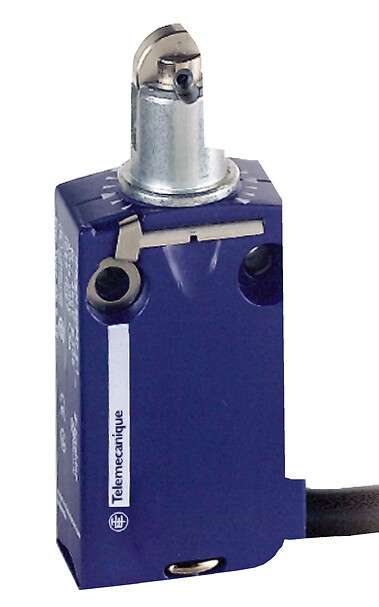
Telemecanique XCMD2102L5 Limit Switch: Steel Roller Plunger Control with 5 m Cable
When a machine must confirm a physical position—end-of-stroke, gate closed, carriage home—mechanical limit switches remain a straightforward and reliable tool. The Telemecanique XCMD2102L5 limit switch is designed for these deterministic tasks, combining a metal body with a steel roller plunger head and a pre-cabled configuration intended for practical field wiring.
This article explains how the Telemecanique XCMD2102L5 limit switch fits into industrial control architectures, what its contact arrangement means for wiring and diagnostics, and how to engineer the actuation geometry so the switch remains repeatable throughout its service life.
What Makes a Roller Plunger Head Useful
A roller plunger reduces friction as the actuator is pressed by a cam or moving part. In applications with sliding contact, that friction reduction can improve mechanical repeatability and reduce wear on both the cam surface and the switch head. The Telemecanique XCMD2102L5 limit switch uses a steel roller plunger head, commonly selected for cam-driven actuation on conveyors, lifts, and guided slides.
Core Technical Characteristics
- Product type: limit switch in the XC Standard range.
- Device short name: XCMD miniature metal style.
- Head type: plunger head with steel roller plunger.
- Contact arrangement: 1NC + 1NO snap action configuration.
- Cable length: 5 m integrated cable for simplified routing to junction boxes.
- Materials: metal body construction intended for industrial durability.
These characteristics position the Telemecanique XCMD2102L5 limit switch for standard machine automation where durability, predictable actuation, and simple wiring dominate selection criteria.
Wiring Logic: Using NC and NO Intelligently
A 1NC + 1NO configuration provides flexibility. In many control philosophies, NC is used for a “healthy circuit” default state, while NO is used for event-based triggering. With the Telemecanique XCMD2102L5 limit switch, you can implement:
- NC contact in a permissive chain to detect broken wires or loose connectors.
- NO contact as an event flag for homing or end-of-travel detection.
Even if you use only one contact in the initial design, the second contact can be reserved for future diagnostics or redundancy without changing mechanical mounting.
Mechanical Actuation Engineering
To keep behavior stable, treat the actuation geometry as a controlled design variable:
- Use a cam surface that engages the roller smoothly, avoiding impact-like strikes.
- Ensure overtravel does not force the plunger beyond its mechanical comfort zone.
- Mount the switch so adjustment is possible during commissioning, then lock fasteners properly.
When a limit switch “fails,” it is often due to misalignment after a mechanical intervention. A documented mounting reference for the Telemecanique XCMD2102L5 limit switch is a low-cost way to reduce recurrence.
Installation and Maintenance Practicalities
The integrated 5 m cable supports routing to a protected termination point. Best practices include:
- Strain relief near the switch body to reduce cable stress from vibration.
- Routing away from hot surfaces and moving pinch points.
- Clear labeling at the termination so technicians can trace signals quickly.
For cross-family installation consistency and related accessory guidance, see Telemecanique sensor resources to align cabling and switch integration patterns across machine zones.
FAQ
- What actuator type does the Telemecanique XCMD2102L5 limit switch use?
It uses a plunger head with a steel roller plunger. - What contacts are provided?
It is specified with 1NC + 1NO snap action contacts. - Why choose a 5 m pre-cabled version?
It simplifies routing to a junction point and reduces field termination variability. - What is the most common cause of inconsistent switching?
Cam misalignment or mechanical drift after maintenance work. - How can I improve troubleshooting speed?
Document the actuation point, label terminations clearly, and standardize wiring logic across similar machines.
With disciplined mechanical actuation and clean wiring practices, the Telemecanique XCMD2102L5 limit switch provides deterministic feedback that supports reliable homing, interlocks, and end-of-travel confirmation.