
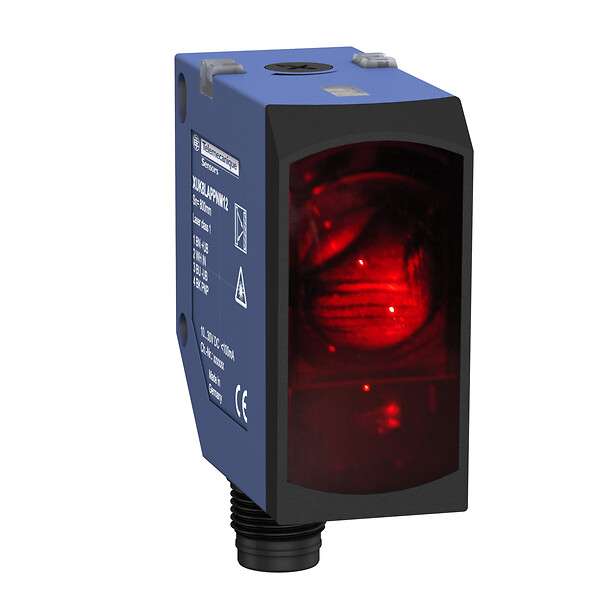
Telemecanique XUK8APSML02M12 Laser Sensor: Diffuse Sensing with Background Suppression
Laser photoelectric sensors are often chosen when you need tight spot detection, stable switching edges, and repeatable positioning in compact machines. The Telemecanique XUK8APSML02M12 laser sensor is designed for diffuse detection with background suppression, a combination that helps the sensor focus on the intended target while reducing false triggers from distant surfaces.
This guide explains how the Telemecanique XUK8APSML02M12 laser sensor behaves in practical automation scenarios, what its key specifications imply for mounting and wiring, and how to plan a reliable setup that stays stable after maintenance and product changeovers.
Concept: Diffuse Sensing with Background Suppression
Diffuse sensors detect objects by measuring light reflected directly from the target. The challenge is that backgrounds—guards, frames, or conveyor rails—can also reflect light and create unwanted switching. Background suppression reduces that risk by helping the sensor ignore reflections beyond a defined zone.
In application terms, the Telemecanique XUK8APSML02M12 laser sensor is often used when the target is close and the background is further away, such as small parts on a fixture with a metallic base plate behind them.
Key Technical Characteristics
- Sensor family: XU photoelectric sensors, XUK nameplate.
- Light source: laser class photoelectric sensing for precise detection geometry.
- Detection system: diffuse with background suppression.
- Supply: DC supply class, commonly specified as 10–30 VDC.
- Output: discrete switching output used for PLC digital inputs.
- Form factor: compact 50 × 50 style sensor design.
- Connection: M12 connector for robust field wiring and quick replacement.
These characteristics position the Telemecanique XUK8APSML02M12 laser sensor for compact automation cells where precise detection and connectorized serviceability are required.
Typical Use Cases
- Part presence verification on assembly fixtures where the background is a reflective metal plate.
- Edge detection or gap detection where the laser spot improves repeatability.
- High-density machines where mounting space is limited and cable management must remain clean.
- Packaging tasks where the sensor must ignore distant guarding or frame members.
For each use case, the aim is the same: maintain consistent switching across normal variation in product color, surface texture, and minor mechanical drift.
Mounting and Setup Discipline
For stable behavior with the Telemecanique XUK8APSML02M12 laser sensor:
- Mount the sensor on a rigid bracket to keep the laser spot fixed relative to the target.
- Keep the background outside the suppression threshold whenever possible.
- Validate with the real product, not an idealized test object.
- Document the alignment position and standoff distance used at commissioning.
Background suppression improves resilience, but it does not replace sound mechanical design. A vibrating bracket will still cause the spot to wander, which can appear like “random” signal noise.
Wiring Integration with Control Systems
The M12 connector format simplifies replacement. The practical consideration is to standardize pinouts and cable routes so a replacement does not introduce wiring swaps. When commissioning the Telemecanique XUK8APSML02M12 laser sensor, confirm:
- Correct PLC input type and logic level for the discrete output.
- Clean 24 V DC supply routing, avoiding shared return paths with high-inrush loads.
- Stable cable strain relief near the sensor to prevent connector loosening.
For broader product-family alignment and accessory matching, see Telemecanique sensor references for consistent cabling conventions across XU families.
FAQ
- What detection system does the Telemecanique XUK8APSML02M12 laser sensor use?
It uses diffuse detection with background suppression. - Why is background suppression useful?
It helps reduce false detection from distant reflective surfaces behind the target. - What supply voltage class is typical?
It is specified for DC supply commonly in the 10–30 VDC range. - What connector does it use?
It uses an M12 connector for robust and serviceable wiring. - What is the most common setup issue?
Aligning on a test object instead of the real product, which can produce unexpected switching after changeover.
When deployed with rigid mounting and real-world validation, the Telemecanique XUK8APSML02M12 laser sensor delivers precise detection while staying resilient against background reflections that commonly disrupt diffuse photoelectric sensing.