
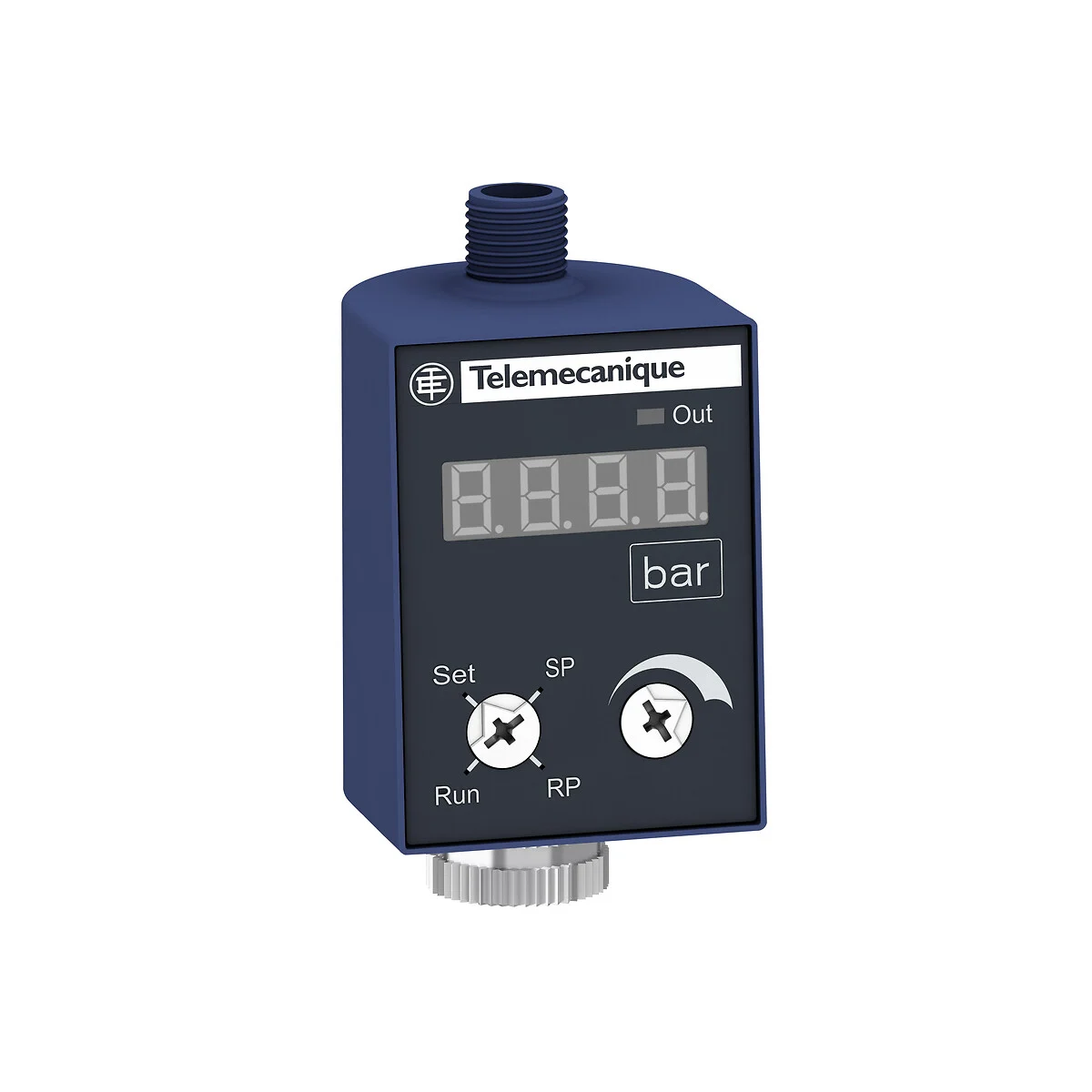
Telemecanique XMLP016BC71F-SM-01 Pressure Transmitter: Technical Guide for 0–16 bar Measurement
In industrial automation, pressure is often the earliest indicator of drift in a process: clogged filters, unstable pumps, air leaks, and regulator deviations usually show up as a pressure anomaly before anything else. The Telemecanique XMLP016BC71F-SM-01 pressure transmitter is built for these practical realities, translating pressure into a stable analog signal that PLCs, controllers, and monitoring systems can consume with minimal conditioning.
This article explains how the Telemecanique XMLP016BC71F-SM-01 pressure transmitter fits into real installations, what its electrical and mechanical characteristics imply for integration, and which design decisions help you avoid nuisance behavior during commissioning.
What the Device Is (and Why It Matters)
The Telemecanique XMLP016BC71F-SM-01 pressure transmitter belongs to the XM pressure sensing family and is designed as a transmitter rather than a simple switch. That distinction is important: instead of a single trip point, you get a continuous measurement. In practice, this makes trending, preventive maintenance, and closed-loop control far more achievable than with threshold-only devices.
Because many plants standardize on analog signals, the Telemecanique XMLP016BC71F-SM-01 pressure transmitter uses a voltage output that can be scaled in the controller to represent the full operating range. This is particularly helpful when you want rapid fault detection without relying on multiple setpoints.
Core Technical Characteristics
- Pressure range: suited to 0–16 bar class applications.
- Analog output: 0–10 V, commonly used for controller analog input modules.
- Supply: typical 24 V DC class supply range used in automation panels.
- Process connection: G 1/4A male, widely compatible with industrial fittings.
- Electrical interface: DIN-style connector format for compact wiring in cabinets and machines.
When you standardize your analog I/O and connectors, you reduce spare-part complexity. The Telemecanique XMLP016BC71F-SM-01 pressure transmitter aligns well with that strategy, since both its electrical and mechanical interfaces are conventional in industrial environments.
Integration Notes for PLC and Control Systems
Most analog voltage inputs are sensitive to grounding and cable routing. For best results with the Telemecanique XMLP016BC71F-SM-01 pressure transmitter:
- Use a clean 24 V DC supply rail and avoid sharing the same supply path with high-inrush loads.
- Route analog cables away from VFD outputs and contactor-heavy bundles.
- Apply consistent scaling in the PLC so the 0–10 V signal maps directly to your engineering units.
In dashboards, you can convert the analog value into trend lines and rate-of-change alarms. This is where a transmitter-based approach provides value: the Telemecanique XMLP016BC71F-SM-01 pressure transmitter can support early warnings based on drift rather than waiting for a hard limit to be exceeded.
Application Fit: Media and Operating Context
Pressure sensing is rarely abstract—media compatibility and temperature exposure define reliability. The Telemecanique XMLP016BC71F-SM-01 pressure transmitter is typically positioned for common industrial media such as air and hydraulic fluids, and is selected where consistent measurement is required under vibration, washdown, or routine maintenance handling.
For system architects, a good practice is to document the pressure envelope (normal, transient, and accidental) and select a transmitter that remains stable across those regimes. This prevents “mystery” signal jumps during production ramp-up and shutdown.
Wiring and Mechanical Installation Checklist
- Confirm thread compatibility and sealing method on the G 1/4A interface.
- Ensure the connector orientation supports serviceability and avoids tight bend radii.
- Validate analog input configuration (voltage mode) before applying pressure.
- Record baseline readings during commissioning for later diagnostics.
If your environment uses multiple sensor families, keeping consistent cabling and accessories reduces errors. For related options and accessories, see Telemecanique sensor resources for cross-family context and selection logic.
FAQ
- What type of output does the Telemecanique XMLP016BC71F-SM-01 pressure transmitter provide?
It provides an analog 0–10 V signal suitable for PLC voltage inputs. - Which pressure class is the Telemecanique XMLP016BC71F-SM-01 pressure transmitter designed for?
It is used for 0–16 bar class measurement applications. - How should I scale the signal in a controller?
Map 0 V to the minimum range and 10 V to the maximum range in engineering units, then validate with a known reference. - Is a transmitter better than a pressure switch for diagnostics?
Yes—continuous measurement supports trending, drift detection, and process analytics rather than only trip events. - What are common installation mistakes?
Poor cable routing near high-noise power lines, incorrect input mode (current vs voltage), and inconsistent grounding practices.
With correct scaling, routing, and commissioning discipline, the Telemecanique XMLP016BC71F-SM-01 pressure transmitter becomes a dependable signal source for monitoring and control, enabling practical, data-driven maintenance decisions.