
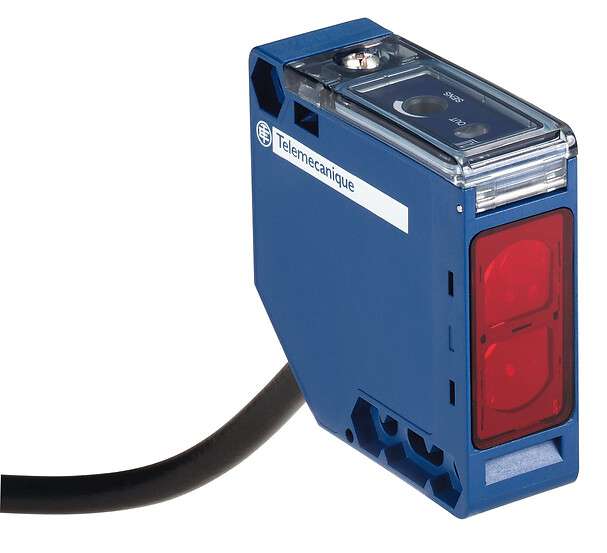
Telemecanique XUK1ARCNL2-SM-03 Photoelectric Sensor: Retro-Reflective Sensing for Stable Industrial Presence Detection
The Telemecanique XUK1ARCNL2-SM-03 photoelectric sensor is a reflex (retro-reflective) photoelectric sensor designed for industrial automation environments where a predictable detection corridor is required. Reflex sensing establishes a defined beam path between the sensor and a reflector. This approach supports repeatable presence detection by measuring the returned beam signal rather than relying solely on the target’s surface reflectivity. As a result, reflex sensors are commonly deployed on conveyors and transfer lines where packaging materials, print patterns, and surface finishes can vary within the same process step.
Technical identity and baseline specification set
- Brand + code + type: Telemecanique XUK1ARCNL2-SM-03 photoelectric sensor
- Sensing function: Reflex (retro-reflective) detection
- Distance class: Sn 7 m
- Supply: 24…240 VAC/DC wide-range
- Output interface: SPDT relay output
- Switching class: 100 mA output class
- Connection: Fixed cable, 2 m class
- Visual diagnostics: Green power LED, yellow output LED
These base characteristics are documented for the XUK1ARCNL2 family reference.
Retro-reflective corridor: what it controls in real machines
In the Telemecanique XUK1ARCNL2-SM-03 photoelectric sensor, the reflector becomes part of the measurement system. The detection decision is made by evaluating the beam returned from the reflector. If the target interrupts the corridor, the returned signal changes and the relay output switches. This corridor-based method provides strong operational consistency in lines where products vary. The engineering priority becomes maintaining corridor integrity: stable mounting, clean reflector surface, and controlled line-of-sight.
Distance class governance and alignment strategy
With Sn 7 m class, the Telemecanique XUK1ARCNL2-SM-03 photoelectric sensor supports extended installation geometries.
Longer corridors can be beneficial, but they require disciplined alignment: a small mechanical drift at the sensor can produce meaningful beam offset at the reflector. Best practice is to mount the sensor and reflector on rigid reference points, avoid thin sheet brackets that can flex, and record an alignment baseline during commissioning so that replacement work can restore the same geometry quickly.
Wide-range AC/DC supply: electrical integration discipline
The 24…240 VAC/DC supply range provides integration flexibility in plants that include both AC and DC field distribution. :
In control design, wide-range devices reduce the number of variants engineers must qualify. In field installation, the non-negotiable requirement is correct protective coordination and wiring verification. The Telemecanique XUK1ARCNL2-SM-03 photoelectric sensor should be integrated with clear labeling and documented isolation points to support safe maintenance.
SPDT relay output: circuit behavior and interface boundaries
The SPDT relay output associated with the XUK1ARCNL2 platform enables a versatile interface to PLC input circuits and relay logic.
From a technical standpoint, relay outputs are chosen when a contact-based interface is preferred, including situations where the control side is not strictly DC transistor input. To preserve performance, switching duty should remain within intended limits, and inductive load management should be applied where relevant. The technical aim is consistent switching and reduced contact stress across repetitive cycles.
Cable connection and LED visibility: operational troubleshooting
A fixed cable (2 m class) simplifies installation into junction points and supports standardized harness routing.
The green power LED and yellow output LED provide immediate diagnostics: power presence and switching state can be verified without tools. In practice, these indicators reduce downtime because technicians can quickly determine whether an issue is related to corridor alignment, reflector contamination, target presentation, or wiring conditions.
“SM-03” variant control: exact reference continuity
Suffix variants such as “SM-03” are typically handled as exact-order identifiers that preserve project procurement consistency while relying on the same core platform specification set. The operational requirement is to maintain the complete name Telemecanique XUK1ARCNL2-SM-03 photoelectric sensor in documentation to prevent unintended substitutions and to keep maintenance spares aligned with the installed baseline.
Required internal link placement: Telemecanique sensor.
FAQ
- What sensing mode is used?
The Telemecanique XUK1ARCNL2-SM-03 photoelectric sensor uses reflex (retro-reflective) sensing with a reflector. - What distance class is associated with this platform?
Sn 7 m class is specified for the XUK1ARCNL2 family reference. - What supply voltage range is supported?
24…240 VAC/DC wide-range supply is documented for the family platform. - What output type is used?
SPDT relay output is listed for the family reference. - How can technicians validate operation quickly?
Using the power and output LEDs to confirm energized state and switching response.
Entity recap: The Telemecanique XUK1ARCNL2-SM-03 photoelectric sensor is a retro-reflective reflex sensor with Sn 7 m class, 24…240 VAC/DC supply capability, and SPDT relay output for stable industrial presence detection.