
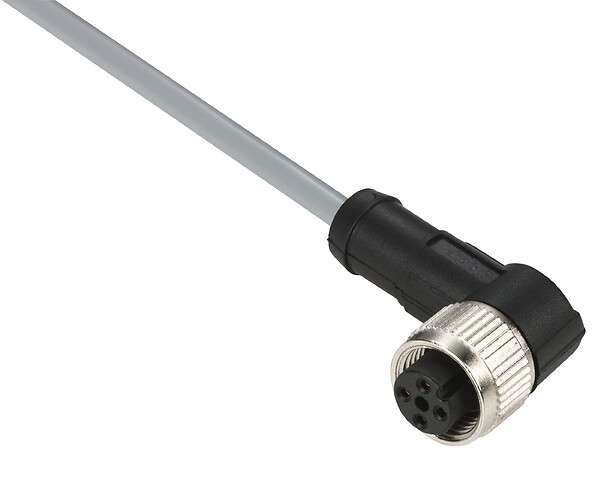
Telemecanique XZCPV1241L10 Pre-Wired Connector: Elbowed Female M12 4-Pin PVC Cable 10 m
The Telemecanique XZCPV1241L10 pre-wired connector is a cabling component intended for installations where an angled connector head improves mechanical clearance, cable routing discipline, and connector strain management. In industrial automation, connector geometry can determine whether cables can be routed cleanly in tight machine envelopes without bending stress at the connector interface. The Telemecanique XZCPV1241L10 pre-wired connector addresses this through an elbowed female M12 connector format with a 4-pin configuration and a 10 m PVC cable, supporting structured wiring across sensors and field devices.
Product identity and geometry
- Brand + code + type: Telemecanique XZCPV1241L10 pre-wired connector
- Connector head: Elbowed female connector
- Interface: M12
- Pin count: 4 pins
- Cable jacket: PVC
- Cable length: 10 m
Elbowed connector value in machine design
In compact machines, straight connectors can force aggressive cable bends immediately after the connector, which increases mechanical stress and raises the probability of conductor fatigue over time. The Telemecanique XZCPV1241L10 pre-wired connector uses an elbowed head to improve clearance and enable a more controlled cable exit direction. This supports cleaner harness routing, reduces interference with moving parts, and helps maintain connector sealing integrity by minimizing repeated bending at the interface.
4-pin interface governance and electrical consistency
The Telemecanique XZCPV1241L10 pre-wired connector uses a 4-pin M12 topology commonly applied for DC sensors and compact field devices. The primary engineering goal is consistency: pin mapping must match the device and the IO endpoint. A disciplined approach includes documenting the connector scheme in the electrical drawings, verifying continuity in commissioning, and maintaining consistent color mapping conventions across the plant. This reduces troubleshooting time and supports predictable device replacement.
PVC cable and routing discipline
For the Telemecanique XZCPV1241L10 pre-wired connector, PVC cabling aligns with general-purpose industrial routing when installed with correct bend radius, protection against abrasion, and appropriate strain relief. Cable management should prioritize separation from high-power drives where practical, avoid pinch points, and secure the harness so motion does not transfer into connector torque. Controlled routing increases long-term availability and reduces intermittent faults caused by micro-breaks.
Operational maintenance and replacement workflow
Pre-wired cordsets are selected to reduce field termination variability. With the Telemecanique XZCPV1241L10 pre-wired connector, maintenance teams can replace a damaged cable assembly quickly without re-terminating conductors in the field. This improves uptime and supports standardized spare strategies, particularly when identical machines are deployed across multiple lines and cable assemblies must be interchangeable.
Where elbowed cordsets are typically preferred
The Telemecanique XZCPV1241L10 pre-wired connector is particularly suitable when sensors are mounted near guards, tooling, or structural frames that limit straight connector clearance. It is also beneficial when cable routing must turn immediately after the connector to enter cable tracks or tight harness corridors. In these environments, connector geometry is a technical requirement that supports mechanical longevity and wiring governance.
For related field device context, see Telemecanique sensor.
FAQ
- Is XZCPV1241L10 a sensor?
No. The Telemecanique XZCPV1241L10 pre-wired connector is a cabling accessory for sensor connectivity. - What is the connector format?
It is an elbowed female M12 connector. - How many pins are used?
The Telemecanique XZCPV1241L10 pre-wired connector uses a 4-pin layout. - What cable length is specified?
It is a 10 m PVC cable assembly. - Why choose elbowed vs straight?
Elbowed geometry supports better clearance and reduces bending stress at the connector interface.