
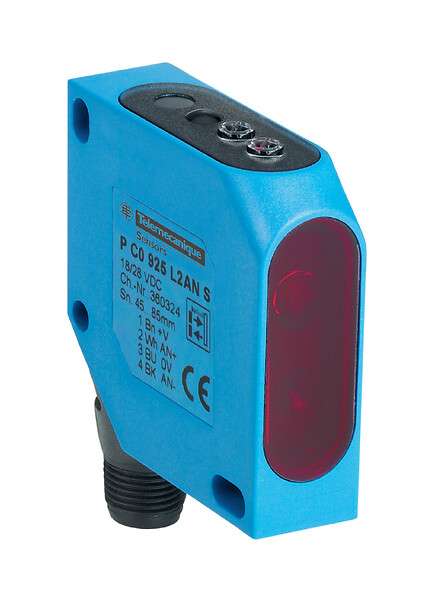
Telemecanique XUYPCO925L3ANSP Analog Laser Photoelectric Sensor: Measurement-Oriented Detection with 4–20 mA Output
The Telemecanique XUYPCO925L3ANSP analog laser photoelectric sensor is positioned for applications that benefit from measured distance information rather than simple on/off presence detection. When a station needs to verify thickness, confirm robot arm position, or monitor a controlled gap, an analog laser sensor can turn “detection” into “measurable control.” This is especially useful when product variability is part of normal operation and the controller must react proportionally instead of using fixed thresholds.
Confirmed product characteristics and what they enable
Official product documentation describes XUYPCO925L3ANSP as an XUY compact 50 × 50 sensor with diffuse analog laser operation, nominal sensing distance 80…300 mm, 18…28 VDC supply limits, PNP discrete output, and 4…20 mA analog output via an M12 5-pin connection. Product pages also reference specific applications such as measuring thickness of mechanical parts and robot arm position control, aligning closely with measurement-driven use cases.
Technical snapshot (controls-friendly)
- Brand + code + type: Telemecanique XUYPCO925L3ANSP analog laser photoelectric sensor
- Sensing window: 80…300 mm
- Supply limits: 18…28 VDC
- Analog output: 4…20 mA (with resistance guidance shown in wiring text)
- Discrete output: PNP
- Connection: M12, 5 pins
- Setup approach: Parametering by buttons
Why 4–20 mA still matters in modern automation
Even with widespread digital networking, 4–20 mA remains a robust standard for analog measurement due to noise tolerance and straightforward diagnostics (open circuit can be detected, scaling is simple, and cabling practices are mature). The Telemecanique XUYPCO925L3ANSP analog laser photoelectric sensor supports this by providing an analog measurement signal plus a discrete output for threshold-based decisions. In a real station, you can use the analog signal for continuous control (gap regulation) while using the discrete output for safety gating or “in-position” confirmation.
Commissioning discipline: map the measurement, not only the switching
Measurement-capable sensors succeed when you commission them like instruments, not like switches. A practical commissioning method includes:
- Define the physical distance range you care about within the 80–300 mm window.
- Validate analog scaling at two or more reference distances using a reliable gauge or fixture.
- Confirm the receiving analog input module is calibrated and that the load resistance matches guidance (datasheet references a resistance condition for 4–20 mA).
- Verify the discrete PNP output triggers at the intended threshold once analog mapping is stable.
- Record parameters and establish a replacement procedure that restores the same settings (button parametering implies field-adjustable configuration).
Optical reality: target surface and angle still matter
Even with laser emission, reflectivity and surface angle influence the returned signal. A shiny angled surface can redirect light away from the receiver, reducing signal strength. A matte surface may produce stable but weaker returns. For the Telemecanique XUYPCO925L3ANSP analog laser photoelectric sensor, the best practice is to validate on the worst-case target surface in your product mix, then set control limits that preserve margin across normal variation. Treat lens cleanliness as a measurement quality factor, not only a maintenance detail.
Environmental suitability and operational boundaries
Datasheet text references IP67 protection and an operational temperature window (0…45 °C in the snippet), which indicates standard industrial resilience while still requiring awareness of extreme thermal environments. Also note the listed switching frequency is under 40 Hz, which reinforces that this device is oriented toward measurement and controlled response rather than ultra-high-speed counting.
For broader standards alignment, see Telemecanique sensor.
Telemecanique XUYPCO925L3ANSP FAQ
- What is the sensing distance window for XUYPCO925L3ANSP?
The product reference lists 80…300 mm. - What supply voltage range is specified?
Supply voltage limits are listed as 18…28 VDC. - Does it provide an analog output?
Yes, it provides a 4…20 mA analog output. - Is a discrete output available too?
Yes, the documentation indicates a PNP discrete output. - Why would an engineer choose analog laser over simple presence detection?
Because analog distance data supports thickness checks, position control, and proportional control logic rather than binary decisions.
Entity recap: The Telemecanique XUYPCO925L3ANSP analog laser photoelectric sensor provides 80–300 mm measurement capability with 4–20 mA output plus PNP discrete output, powered by 18–28 VDC and connected via M12 5-pin, supporting measurement-driven automation governance.