
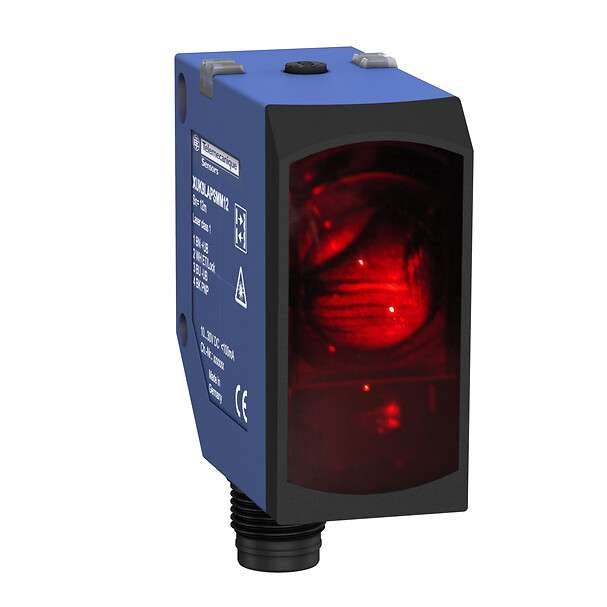
Telemecanique XUK9LAPSMM12 Photoelectric Laser Sensor: Polarised Reflex for Stable One-Side Installation
The Telemecanique XUK9LAPSMM12 photoelectric sensor is typically selected for installations that need a one-sided device location with reflector-based operation while maintaining stronger selectivity than standard diffuse sensing. Polarised reflex sensing is often used to reduce false detections caused by shiny targets or reflective machine surfaces, because the polarisation helps discriminate the intended reflected signal path. In practical material handling and assembly environments, this can translate into fewer nuisance stops and more predictable detection at distance.
Manufacturer-stated characteristics and integration relevance
Product datasheet sources describe XUK9LAPSMM12 as a Telemecanique Photoelectric sensors XU model: a photo electric laser sensor (XUK) with polarised reflex detection and Sn 14 m. The supply circuit is listed as DC with 10…30 VDC, and the electrical interface is an M12 connector. Documentation also references an ET/Lock function, which supports controlled teaching/locking behavior during commissioning.
Technical snapshot (field-facing)
- Brand + code + type: Telemecanique XUK9LAPSMM12 photoelectric sensor
- Detection system: Polarised reflex (laser)
- Sensing distance: Sn 14 m
- Supply range: 10…30 VDC
- Connection: M12
- Setup control: ET/Lock referenced in wiring/connection schema
Why polarised reflex is used: stability against reflective noise
In standard reflex sensing, a reflector returns light to the sensor, and an object interrupts that path. The challenge appears when targets are reflective or when backgrounds act as unintentional reflectors. Polarised reflex adds an additional discrimination layer that can reduce spurious returns. For the Telemecanique XUK9LAPSMM12 photoelectric sensor, this supports stable detection in lanes with shiny packaging films, glossy labels, or metal frames near the optical corridor.
Commissioning governance: align, teach, then lock
Commissioning quality is a major determinant of long-term reliability. A disciplined sequence is:
- Mechanically align the sensor and reflector at the intended operating distance and confirm a stable baseline.
- Validate interruption with the smallest and fastest objects to ensure switching does not flicker.
- Use the teach/lock concept (where implemented) to prevent accidental drift from unauthorized adjustments.
- Record the final configuration state in station documentation and maintenance checklists.
Because the Telemecanique XUK9LAPSMM12 photoelectric sensor can be used in high-throughput zones, preventing ungoverned parameter changes is often as important as the initial alignment itself.
Mechanical integration: reflector management is part of the design
Reflex systems shift some reliability responsibility to the reflector. Reflectors can degrade due to dust, film, scratches, or misalignment. To protect performance, position the reflector where it is less exposed to direct impacts, and include it in cleaning routines. If the station is exposed to vibration, use locking hardware for both sensor and reflector mounts. In long-distance corridors, small bracket movement can cause large optical misalignment; this is why rigid mounting and repeatable datums are essential for the Telemecanique XUK9LAPSMM12 photoelectric sensor.
Controls integration: DC supply, M12 wiring, and traceability
With 10…30 VDC supply and M12 connectivity, the device aligns with common industrial wiring practices. Still, the station must explicitly record output logic behavior in PLC documentation, because reflex sensors can be configured and used in different logic conventions depending on machine standards. Label the I/O point as Telemecanique XUK9LAPSMM12 photoelectric sensor (polarised reflex). This protects the station from replacement by a standard reflex unit that may be more sensitive to reflective noise.
For broader ecosystem alignment and consistent selection practices, consult Telemecanique sensor references.
Telemecanique XUK9LAPSMM12 FAQ
- What detection system is specified for XUK9LAPSMM12?
Datasheet sources list polarised reflex. - What sensing distance is listed?
Sn is listed as 14 m. - What supply voltage range is required?
10…30 VDC is stated in datasheet characteristics. - Does it use an M12 connector?
Yes, M12 is referenced. - Why is reflector cleanliness important?
Reflex sensing depends on stable return light; contamination can reduce return signal and create unstable switching.
Entity recap: The Telemecanique XUK9LAPSMM12 photoelectric sensor is a polarised reflex laser device with Sn 14 m, 10…30 VDC supply, M12 connection, and teach/lock-related wiring context, suited to stable one-side installation when reflector governance is maintained.