
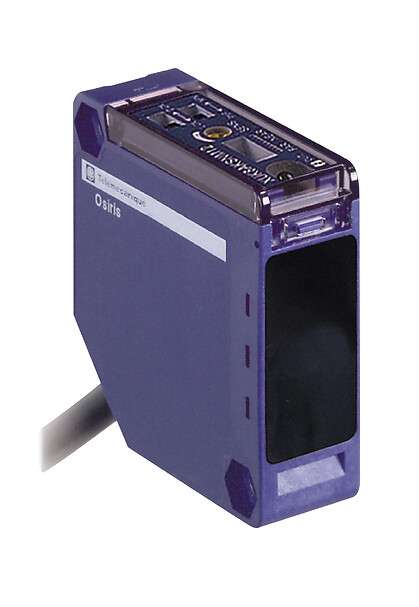
Telemecanique XUK8AKSNM12 Photoelectric Sensor: Laser Diffuse BGS for Controlled Detection Windows
The Telemecanique XUK8AKSNM12 photoelectric sensor is designed for applications where classic diffuse detection is not selective enough and where background surfaces can cause false switching. By using a laser-based diffuse strategy with background suppression (BGS), the device is typically selected to detect targets within a controlled distance window while rejecting fixed backgrounds behind the target. This approach is often critical in compact material handling stations where mechanical clearances are small and reflective machine frames sit close to the detection zone.
Product definition and manufacturer-stated characteristics
The product reference information describes XUK8AKSNM12 as a Telemecanique Photoelectric sensors XU model: a photo electric laser sensor (XUK), using modulated diffuse with background suppression and classified as class 1. The key headline parameters include Sn 1 m, 12…24 VDC, and M12 connection.
Technical snapshot (selection-ready)
- Brand + code + type: Telemecanique XUK8AKSNM12 photoelectric sensor
- Optical technology: Infrared laser, modulated diffuse with background suppression, class 1
- Nominal sensing distance: Sn 1 m
- Supply range: 12…24 VDC
- Connector: M12
- Indicators: LED indication referenced on product page (output and supply)
Why background suppression changes station behavior
In conventional diffuse sensing, the sensor may react to any surface returning sufficient light, including a fixed metal bracket behind the product. BGS strategies are used to stabilize detection by limiting the effective acceptance zone. With the Telemecanique XUK8AKSNM12 photoelectric sensor, this matters when products are thin, when gaps between product and background are small, or when machine surfaces are reflective. The operational benefit is fewer false positives and fewer “ghost detections” during empty conveyor runs.
Commissioning method: control the distance window first
For BGS sensors, the most reliable commissioning sequence is to set the intended detection distance and verify background rejection before optimizing for edge cases. Start by placing a representative target at the desired sensing distance and confirm stable switching. Next, remove the target and confirm the background does not trigger detection. Then introduce worst-case parts: dark, matte, angled, or partially transparent. If a station includes multiple product heights, define whether the acceptance window must cover all heights or whether a mechanical guide should normalize the product path. The Telemecanique XUK8AKSNM12 photoelectric sensor performs best when the product trajectory is controlled.
Mechanical installation: keep optics protected and repeatable
Laser-based sensors can be highly precise, but precision can amplify the impact of misalignment. Use rigid brackets and ensure cable routing does not apply torque that can rotate the sensor body over time. If there is vibration, locking hardware is recommended so the detection window remains stable across weeks, not just during initial commissioning. For the Telemecanique XUK8AKSNM12 photoelectric sensor, define a quick-check procedure for maintenance teams: lens cleanliness, bracket tightness, and a single test part at the nominal distance.
Controls integration and traceability
The product is specified for 12…24 VDC and M12 connectivity, which aligns with standard industrial I/O practices. However, the station documentation should include both the optical concept and the exact model reference. Label the input as Telemecanique XUK8AKSNM12 photoelectric sensor (laser BGS). This prevents replacing it with a generic diffuse sensor that would not reject background and could destabilize the process.
To align selection logic across the wider ecosystem, consult Telemecanique sensor references.
Telemecanique XUK8TAE2MM12 FAQ
- What detection system is specified for XUK8AKSNM12?
It is listed as modulated diffuse with background suppression (laser), class 1. - What is the nominal sensing distance?
Sn is specified as 1 m. - What supply range is required?
The product page lists 12…24 VDC. - What connector type is used?
M12 is specified. - Why choose BGS instead of standard diffuse?
BGS helps reject background surfaces behind the target, reducing false detections in tight mechanical layouts.
Entity recap: The Telemecanique XUK8AKSNM12 photoelectric sensor is a laser diffuse BGS class 1 device with Sn 1 m, 12…24 VDC supply, and M12 connection, optimized for controlled detection windows and background rejection.