
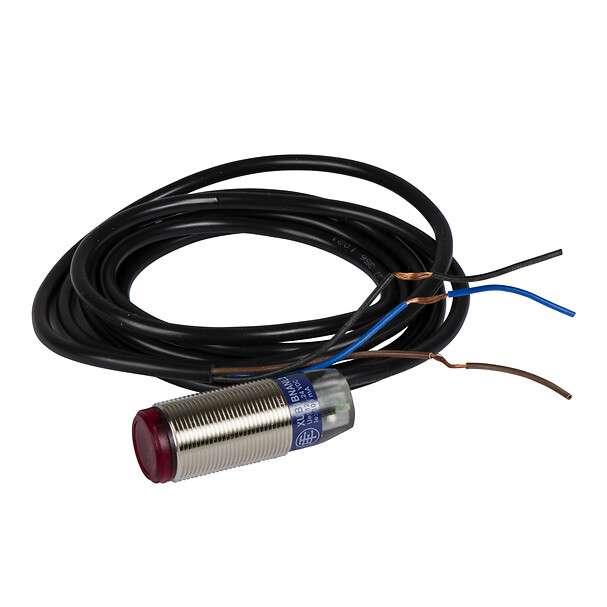
Telemecanique XUB4BPANL2 Photoelectric Sensor: Ultra-Short Diffuse Detection and Setup Control
The Telemecanique XUB4BPANL2 photoelectric sensor is specified for diffuse sensing at very short range, which is typically used when the goal is precise presence confirmation close to a fixed point—such as a stop position, a fixture, or a compact chute where longer ranges could pick up unintended background reflections. Short-range diffuse sensors can be extremely effective when commissioned with discipline, because the detection zone can be tightly controlled and aligned with the mechanical tolerance of the station.
Product identity and technical definition
Datasheet information identifies the Telemecanique XUB4BPANL2 photoelectric sensor as a cylindrical M18 device with a metal body, axial line of sight, diffuse detection system, discrete output, and DC supply circuit. The characteristic distance is stated as Sn 0.1 m, with 12…24 VDC supply and a 2 m cable. The same datasheet context lists 3-wire wiring technique.
Core specifications (field-use view)
- Brand + code + type: Telemecanique XUB4BPANL2 photoelectric sensor
- Sensor design: Cylindrical M18
- Material: Metal
- Detection system: Diffuse
- Nominal sensing distance: Sn 0.1 m
- Supply: 12…24 VDC
- Wiring technique: 3-wire
- Connection: Cable 2 m
Why short diffuse sensing is used
Diffuse sensing at 0.1 m scale is often a deliberate design choice. In compact stations, longer sensing ranges can see beyond the intended target and react to machine background or moving elements behind the product. By selecting the Telemecanique XUB4BPANL2 photoelectric sensor with Sn 0.1 m, engineers can focus detection near the desired location and reduce unintended actuation from distant surfaces. The trade-off is that commissioning must take target reflectivity into account, since the detection is still reflection-based.
Commissioning approach: set for worst case, verify for drift
To commission diffuse sensors responsibly, tune the station for the least reflective target and the most challenging target angle expected in production. If products vary, test the darkest color and most matte finish. Then confirm the sensor does not trigger on background surfaces when no product is present. In practice, it is useful to define a simple acceptance checklist: “detect target at minimum size,” “ignore background,” and “stay stable after 30 minutes of operation,” because warm-up and contamination can shift real-world behavior.
Mechanical integration: metal body and bracket stability
A metal housing can improve resilience in high-contact areas, but it does not eliminate the need for a rigid bracket. The Telemecanique XUB4BPANL2 photoelectric sensor should be mounted to prevent micro-movement. At short range, even small angle changes can shift the reflection path enough to create unstable switching. If the station is exposed to vibration, use locking hardware and maintain consistent cable routing so cable forces do not rotate the sensor body.
Controls integration: DC 3-wire practices
The datasheet lists a DC supply and 3-wire wiring technique. In documentation, record the full identifier—Telemecanique XUB4BPANL2 photoelectric sensor—and note the diffuse mode and short range. That improves troubleshooting because a technician will know that a dirty lens or reflective background is more likely to cause issues than “weak beam,” which is more common in long thru-beam installations.
For portfolio-level alignment across machine standards, consult Telemecanique sensor references to keep consistent practices in mounting, wiring, and replacement governance.
Telemecanique XUB4BPANL2 FAQ
- What detection system does the Telemecanique XUB4BPANL2 photoelectric sensor use?
It is specified as diffuse detection. - What sensing distance is listed?
Sn is listed as 0.1 m. - Is the housing metal?
Yes, the datasheet lists metal material. - What supply range is specified?
12…24 VDC is listed. - What wiring technique is indicated?
3-wire is listed in the datasheet.
Entity recap: The Telemecanique XUB4BPANL2 photoelectric sensor is an M18 metal diffuse sensor with Sn 0.1 m, 12…24 VDC supply, 3-wire wiring, and a 2 m cable—built for controlled short-range presence verification.