
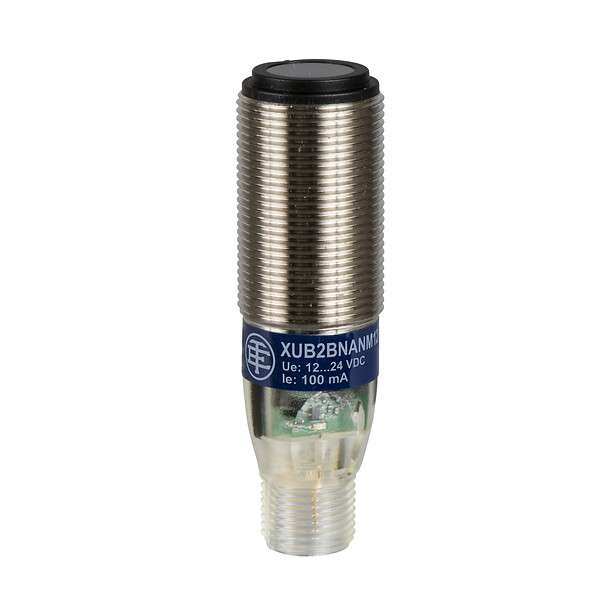
Telemecanique XUB1BPANM12 Photoelectric Sensor: Reflective Detection with PNP NO Output
The Telemecanique XUB1BPANM12 photoelectric sensor is commonly deployed where reflective sensing provides a practical balance between installation effort and detection reliability. Reflective photoelectric sensing can reduce mechanical complexity compared to thru-beam (no separate receiver alignment across long spans), while still offering consistent detection when the optical path and reflective target are properly managed.
Product identity
The Telemecanique XUB1BPANM12 photoelectric sensor is presented in distributor documentation as a reflective optical sensor with 4 m range and a PNP NO output style. It is associated with the XUB cylindrical platform and uses an M12 connection convention, supporting standard DC control architectures.
Key technical characteristics
- Brand + code + type: Telemecanique XUB1BPANM12 photoelectric sensor
- Detection concept: Reflective optical sensing (reflective sensor context)
- Range: 4 m (reflective)
- Output style: PNP, normally open (NO)
- Datasheet availability: PDF documentation available
Reflective sensing: practical behavior and constraints
Reflective photoelectric sensing typically relies on a reflector or reflective target to return the emitted light to the receiver. The operational advantage is simpler mechanical design: the Telemecanique XUB1BPANM12 photoelectric sensor can often be mounted on one side of the conveyor or machine opening while the reflector is placed on the opposite side. However, reflective applications require governance around cleanliness and alignment. Contamination on the sensor lens or the reflector surface can reduce returned light, making the detection threshold more sensitive. This is why reflective sensor installations should be validated under real production conditions rather than only in a clean commissioning environment.
PNP NO output: integration discipline
The PNP NO output is a common standard in many DC automation panels, but it still needs explicit documentation to avoid substitution errors. A frequent downtime driver is replacing a sensor with the same mechanical form factor but different output logic. To reduce risk, label the point as Telemecanique XUB1BPANM12 photoelectric sensor (PNP NO) and keep the reference consistent in the maintenance bill of materials. Distributor sources explicitly describe this model as PNP NO, reinforcing the need for correct spare selection.
Commissioning methodology
- Align sensor to reflector and confirm stable signal with empty conveyor.
- Introduce product at minimum and maximum expected sizes and validate switching stability.
- Check operation under typical ambient light and any nearby reflective surfaces.
- Record the final alignment and cleaning intervals as part of site standards.
Where this model fits best
The Telemecanique XUB1BPANM12 photoelectric sensor is typically a fit where a mid-range reflective solution (4 m) is sufficient and where the environment allows periodic inspection of reflector cleanliness. It can be used for presence detection, gap checking, simple counting, and verifying that a product stream is actually flowing through a defined passage. The reflective approach is often selected in packaging, intralogistics, and assembly cells where bracket space is limited or where running a thru-beam receiver cable is undesirable.
Maintenance and troubleshooting signals
When the detection becomes unstable, first inspect the optical surfaces—lens and reflector—then verify bracket rigidity. Next, confirm the electrical side: DC supply stability and correct PLC input referencing for PNP outputs. If the sensor toggles but the PLC does not, focus on wiring continuity and input configuration rather than immediately replacing the device. This approach prevents repeated failures driven by root causes like vibration or contamination rather than component defect.
For broader sensor standardization and selection alignment, consult the Telemecanique sensor catalog context and keep installation rules consistent across assets.
FAQ
- What range is associated with the Telemecanique XUB1BPANM12 photoelectric sensor?
It is described as a reflective optical sensor with 4 m range. - What output type does it use?
Distributor documentation indicates PNP NO. - Why choose reflective sensing instead of thru-beam?
Reflective setups can reduce wiring and alignment complexity by using a reflector rather than a separate receiver. - What is a common cause of instability in reflective applications?
Contamination on the lens or reflector can reduce returned light and shift switching stability. - How should it be documented for maintenance accuracy?
Use the full identifier: Telemecanique XUB1BPANM12 photoelectric sensor (PNP NO) to prevent wrong-logic substitutions.