
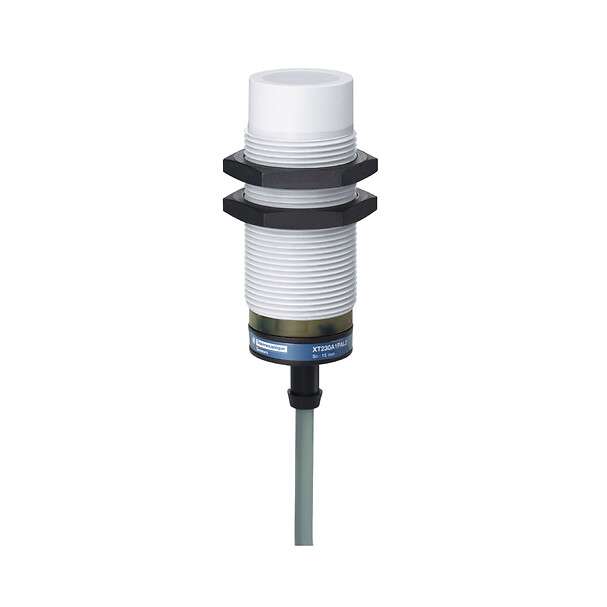
Telemecanique XT230A1FAL2 Capacitive Proximity Sensor: M30 AC NO Specifications
The Telemecanique XT230A1FAL2 capacitive proximity sensor is a robust M30-format capacitive sensor designed for detection of insulated or conductive materials in industrial automation. The larger M30 body is often selected when mechanical durability, mounting stability, and a wider mechanical interface are preferred—especially in production areas where sensor bodies are exposed to routine handling and vibration.
What the XT230A1FAL2 is
The Telemecanique XT230A1FAL2 capacitive proximity sensor is a cylindrical M30 sensor with a plastic enclosure. It is non flush mountable, specified with Sn 15 mm, and uses a 2-wire AC discrete output with 1 NO function. The unit is pre-cabled with a 2 m cable and operates at 24…240 V AC (50/60 Hz).
Key specifications
- Brand + code + type: Telemecanique XT230A1FAL2 capacitive proximity sensor
- Sensor design: Cylindrical M30, fixed body, size 74.5 mm
- Material: Plastic enclosure
- Mounting: Non flush mountable
- Nominal sensing distance (Sn): 15 mm
- Output: Discrete, 2-wire, AC, 1 NO
- Supply: 24…240 V AC (50/60 Hz)
- Response time: 30 ms
- Protection: IP67 double insulation
- Switching frequency: ≤ 25 Hz
Operational value of 15 mm Sn in capacitive sensing
For capacitive sensing, a larger nominal distance can help when targets vary in density or when the sensor must be placed behind a protective layer. The Telemecanique XT230A1FAL2 capacitive proximity sensor provides Sn 15 mm while still supporting a tunable setup approach. That can be beneficial in processes where the target is not a single rigid part but a variable product stream.
Two-wire AC NO output: wiring expectations
This model is specified as a 2-wire AC sensor with normally open behavior. In practice, it behaves as an inline device, which can be convenient in retrofit projects. The governance rule is clarity: document it explicitly as Telemecanique XT230A1FAL2 capacitive proximity sensor (2-wire AC, NO) so it is not confused with the NC variant or a DC transistor-output model.
Non-flush mounting: reducing false actuation
Non-flush mounting is frequently used with capacitive sensors to avoid baseline drift caused by nearby metal. Keep appropriate clearance from brackets and surrounding conductive structures to prevent “always on” behavior or reduced adjustment headroom. This is especially important on M30 bodies, which are often installed in robust steel frames.
Typical applications
- Presence detection of non-metallic products in packaging lines
- Material flow confirmation where product type changes over time
- Level or proximity checks through non-metal barriers (application-dependent)
- Retrofit AC installations that standardize on two-wire devices
Maintenance and troubleshooting approach
Capacitive sensors can be influenced by residue and environmental changes. If the switching point shifts, inspect the sensing face for build-up, confirm mounting tightness, and re-check sensitivity tuning under normal operating conditions. Use the LED state as a first-level diagnostic, then validate that AC wiring and load expectations align with a two-wire device.
For consistent selection across sensor families and wiring standards, consult Telemecanique sensor resources to align mounting, output type, and application fit.
FAQ
- Is the Telemecanique XT230A1FAL2 capacitive proximity sensor AC?
Yes. It is rated for 24…240 V AC and uses a 2-wire AC output circuit. - Is the output normally open?
Yes, it is specified as 1 NO. - What is the nominal sensing distance?
Sn is 15 mm. - Is XT230A1FAL2 flush mountable?
No. It is specified as non flush mountable. - What ingress protection does it have?
IP67 double insulation.