
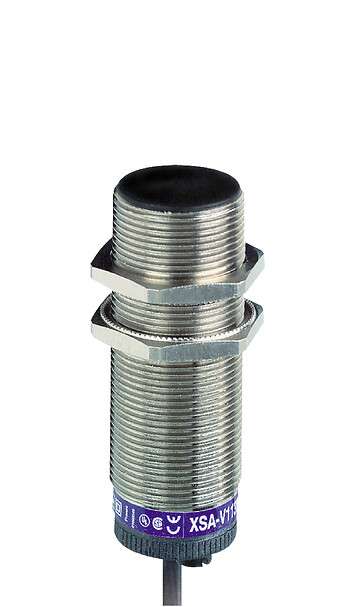
Telemecanique XSAV12801 Inductive Rotation Monitoring Sensor: Technical Guide
The Telemecanique XSAV12801 inductive rotation monitoring sensor is built for applications where “motion present” must be confirmed with high reliability. Instead of acting only as a basic metal presence switch, this device is engineered to monitor rotation by detecting recurring metal targets on rotating components. In industrial operations, that capability supports preventive diagnostics, jam detection, and controlled stop logic without mechanical contact.
Product identity and what it is designed to do
The Telemecanique XSAV12801 inductive rotation monitoring sensor belongs to the Telemecanique XS inductive family and is specified explicitly for rotation monitoring. It uses an M30 cylindrical metal body with a frontal sensing face and a flush-mount installation concept. The headline technical definition includes Sn 10 mm, an adjustable frequency range of 120…3000 cyc/min, and 24…240 VAC/DC supply capability, making it suitable for mixed-voltage environments and retrofit projects where supply standardization is not always possible.
Key specifications (engineering snapshot)
- Brand + code + type: Telemecanique XSAV12801 inductive rotation monitoring sensor
- Sensor design: Cylindrical M30, fixed body, size 81 mm
- Mounting: Flush mountable
- Nominal sensing distance (Sn): 10 mm
- Device application: Rotation monitoring
- Adjustable frequency range: 120…3000 cyc/min
- Output signal: Discrete, 2-wire, AC/DC
- Discrete output function: 1 NC
- Supply voltage: 24…240 V AC (50/60 Hz), 24…210 V DC
- Cable: 2 m
- Protection: IP67
- Switching frequency: ≤ 800 Hz (device switching performance)
- LED: Red LED for output state
How rotation monitoring works in practice
In a rotation monitoring setup, the target is typically a metallic flag, bolt head, or toothed element that passes the sensing face repeatedly. The Telemecanique XSAV12801 inductive rotation monitoring sensor detects these repeated passes and provides a discrete output that a controller can interpret as “rotation present.” When the pulses stop—due to belt slip, shaft stall, broken coupling, or blocked material flow—the controller can trigger alarms or controlled shutdown sequences. The adjustable frequency range (120…3000 cyc/min) is important because it defines the motion envelope the sensor is designed to evaluate.
NC output logic and operational governance
The NC output behavior is frequently selected for supervision-style logic, because abnormal states (loss of supply or wiring fault) can be interpreted as a deviation depending on how the loop is engineered. To avoid field confusion, label the IO point explicitly as Telemecanique XSAV12801 inductive rotation monitoring sensor (2-wire AC/DC, NC). This reduces the risk of replacement with a similar-looking NO model during urgent maintenance interventions.
Installation notes that influence stability
Rotation monitoring depends on repeatable geometry. Ensure the target passes in front of the sensing face with consistent gap and alignment. Because the sensor is flush mountable, it can sit cleanly in a metal bracket, but the bracket must remain rigid over time. In commissioning, validate detection at both the lowest and highest operating speeds within the application window, then confirm that PLC logic interprets “no pulses” as a controlled exception rather than a silent failure. The datasheet also specifies a run-up delay at power-up (9 s standard), which should be considered in start sequences.
If you are standardizing hardware across a line, you can cross-check the wider Telemecanique sensor ecosystem to keep mounting conventions and wiring practices consistent.
FAQ
- What is the Telemecanique XSAV12801 inductive rotation monitoring sensor used for?
It is specified for rotation monitoring and outputs a discrete signal based on detected motion pulses. - What is the adjustable frequency range?
120…3000 cyc/min. - Is XSAV12801 AC, DC, or both?
It is a 2-wire AC/DC device rated for 24…240 V AC and 24…210 V DC. - Is the output normally closed?
Yes, it is specified as 1 NC. - What protection rating does it have?
IP67.