
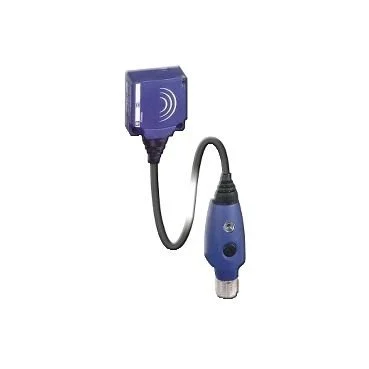
Telemecanique XS9E11RPBL01M12 Inductive Proximity Sensor: Rotation Monitoring Sensor Profile
The Telemecanique XS9E11RPBL01M12 inductive proximity sensor is specialized for rotation monitoring, supporting applications where detecting motion (and loss of motion) is operationally critical. Rather than serving only as a presence sensor, this model is frequently applied to monitor rotating elements, providing a dependable signal foundation for downtime prevention and safety-oriented interlocks.
Product identity and purpose
The Telemecanique XS9E11RPBL01M12 inductive proximity sensor is an inductive proximity sensor designed for rotation monitoring. It uses a flat-form 26 × 26 × 13 sensor element and is intended to detect a metallic reference on a rotating part. An adjustable frequency range supports broad operational envelopes—from low-speed movement checks to faster rotation regimes.
Technical specifications
- Brand + code + type: Telemecanique XS9E11RPBL01M12 inductive proximity sensor
- Application: Rotation monitoring
- Housing: Flat form 26 × 26 × 13, PBT
- Mounting: Flush mountable
- Nominal sensing distance (Sn): 10 mm
- Adjustable frequency range: 6…6000 cyc/min
- Output: Discrete, 3-wire, PNP, 1 NC
- Supply: 12…24 V DC
- Connection: Remote male connector M12, 4 pins; cable length 0.15 m
- Protection: IP67
Why rotation monitoring is different from simple proximity
In rotation monitoring, the question is not only “is the target present?” but “is movement occurring within expected parameters?” The Telemecanique XS9E11RPBL01M12 inductive proximity sensor is designed to generate a dependable switching signal as the metallic target passes the sensing face, enabling control systems to determine whether rotation is present, stalled, or outside expected speed conditions.
NC output: operational logic benefits
The sensor is specified as PNP with a normally closed output function. Many teams select NC outputs when they want fail-aware logic: loss of power or wiring integrity can be detected as an abnormal state. In documentation, tag it clearly as Telemecanique XS9E11RPBL01M12 proximity sensor (rotation monitoring, PNP NC) to avoid confusion with NO variants during maintenance.
Installation notes for reliable motion detection
- Use a stable metal target geometry on the rotating element for consistent pulse generation.
- Maintain a controlled sensor-to-target gap aligned to the application’s mechanical tolerances.
- Secure the remote M12 connection and protect the short 0.15 m cable from repetitive flexing.
- Validate behavior at minimum and maximum machine speeds relevant to the process.
Where this model is typically used
- Conveyor shaft rotation confirmation to detect belt slip or jam conditions
- Fan or pump rotation presence checks for condition monitoring
- Machine safety sequences where “no motion” must be detected quickly
- Predictive maintenance signals based on rotation presence
Maintenance and troubleshooting
Most rotation monitoring issues arise from mechanical changes: shifted bracket, changed target geometry, or contamination at the sensing face. If the output signal becomes inconsistent, verify alignment first, then confirm supply voltage, and finally validate the controller logic that interprets pulses. Using the LED indicators in the field can accelerate root-cause identification during time-sensitive stoppages.
For broader standardization and alternative sensor options within the ecosystem, consult Telemecanique sensor references to align mounting, output type, and environmental protection with your site standards.
FAQ
- What is the key function of the Telemecanique XS9E11RPBL01M12 inductive proximity sensor?
It is designed for rotation monitoring, supporting motion presence detection via inductive sensing. - What is the adjustable frequency range?
It is specified as 6…6000 cyc/min. - Is the output normally closed?
Yes. It is a PNP discrete output with 1 NC function. - What connector does it use?
It uses a remote male M12 4-pin connector with a 0.15 m cable length. - What is the nominal sensing distance?
Sn is specified as 10 mm.