
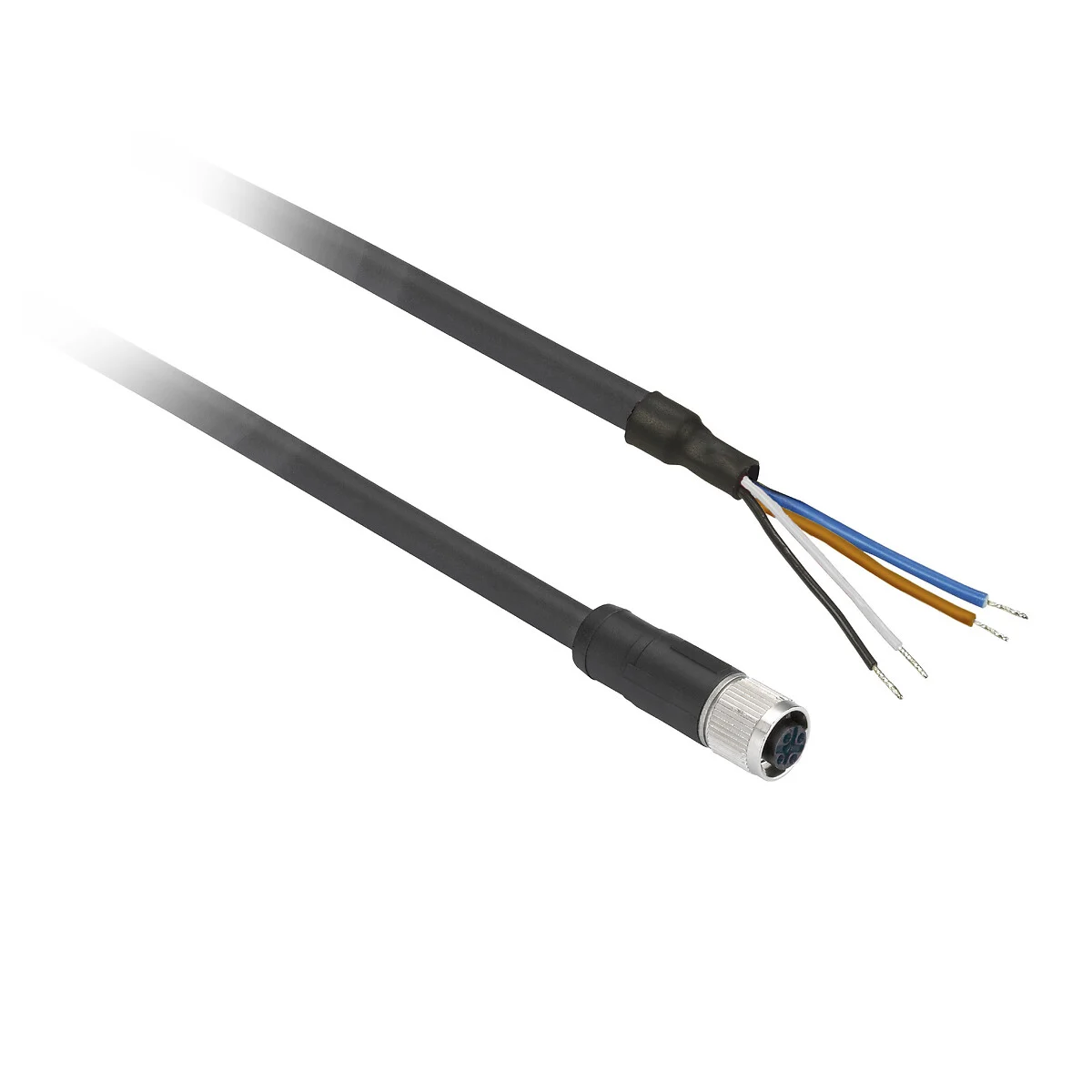
Telemecanique Sensors XMLR010G1P25 Pressure Sensor: 10 bar Measurement with 4–20 mA and One PNP Switching Output
The Telemecanique Sensors XMLR010G1P25 pressure sensor is an electronic pressure transmitter designed for industrial control environments that need both continuous pressure monitoring and a discrete switching decision. This reference is specified around a 10 bar pressure rating and combines an analogue 4–20 mA output with one PNP switching output, using a G 1/4 fluid entry and an M12 electrical interface. In practical automation terms, it supports two complementary tasks: trending pressure as a process variable and confirming a threshold event as a logic signal.
Where the XMLR010G1P25 Fits in a Control Architecture
Many machines operate best when pressure is treated as both a quality indicator and a safety/permissive condition. The Telemecanique Sensors XMLR010G1P25 pressure sensor supports that approach by letting a PLC read an analogue value for diagnostics while also using a switching output to enable or block a sequence step. On pneumatic lines, this can mean “pressure is stable enough to start motion.” On water or compatible fluid circuits, it can be “pressure is present before opening a downstream valve.”
In commissioning and maintenance, having an analogue value often reduces guesswork. A threshold-only device can tell you that pressure is low, but it cannot show whether pressure is slowly drifting, oscillating, or recovering too slowly. The Telemecanique Sensors XMLR010G1P25 pressure sensor gives operators that visibility without adding complexity in the cabinet.
Key Technical Characteristics That Matter in the Field
This reference is documented as an electronic pressure sensor (pressure transmitter) with a 10 bar rating, an analogue 4–20 mA signal, and a transmitter concept that includes one switching output (PNP). The G 1/4 port is common in industrial pressure taps, which helps standardize installation across skids and machines. The M12 connection supports consistent wiring practice and simplifies replacement workflows in the field.
From a usability perspective, the advantage is predictability: technicians can treat the Telemecanique Sensors XMLR010G1P25 pressure sensor as a stable analogue loop device while also mapping the switching output to a digital input for event-based logic.
Installation Guidance for Clean Measurement
Pressure sensors do not fail as often as installations do. To get reliable results from the Telemecanique Sensors XMLR010G1P25 pressure sensor, mount it where the pressure is representative of the process, not where pulsation dominates. Avoid placing it immediately after fast-acting valves that create spikes, unless the purpose is to explicitly observe those spikes. If the process is inherently pulsating, mechanical damping or a calmer tapping point can produce a more stable signal and reduce nuisance switching.
- Keep the port clean: prevent debris from entering the pressure tap during assembly.
- Respect sealing practice: use an appropriate sealing approach for your fitting strategy to prevent micro-leaks.
- Route cabling thoughtfully: keep analogue wiring away from high-power lines where possible to reduce noise pickup.
Commissioning: Make the Outputs Useful, Not Just “Working”
Commissioning should confirm that the PLC value is correctly scaled for a 4–20 mA signal and that the switching output changes state consistently at the intended setpoint. Start by validating the analogue reading against a trusted gauge during initial pressurization. Then, approach the setpoint slowly and verify repeatable switching behavior. If the switching output chatters near the threshold, the cause is often process fluctuation rather than a device defect; stabilizing the pressure signal usually stabilizes the logic input.
When the analogue channel is stable, the Telemecanique Sensors XMLR010G1P25 pressure sensor becomes a diagnostic tool: it can show leak-related decay, regulator drift, or slow recovery that might otherwise remain hidden until downtime occurs.
Maintenance and Troubleshooting Patterns
If a machine begins to behave inconsistently, the fastest troubleshooting path is to interpret the data before replacing parts. A steady analogue value that never reaches the expected level often points to supply issues, leaks, or restrictions. An oscillating signal may indicate pulsation from valves or pumps. A switching output that changes unexpectedly can be the correct reaction to a real pressure drop. Treat the Telemecanique Sensors XMLR010G1P25 pressure sensor as an evidence source for process behavior.
For related product families and selection context, visit Telemecanique sensor.
FAQ
1) What is the XMLR010G1P25?
The Telemecanique Sensors XMLR010G1P25 pressure sensor is an electronic pressure transmitter with an analogue output plus a switching output for control logic.
2) What pressure rating is associated with this reference?
The Telemecanique Sensors XMLR010G1P25 pressure sensor is specified around a 10 bar pressure rating.
3) What outputs does it provide?
It provides a 4–20 mA analogue signal and a PNP switching output for threshold-based decisions.
4) What are the common connection standards?
The device is referenced with a G 1/4 fluid entry and an M12 electrical connection.
5) What causes unstable switching in real installations?
Pressure pulsation near the measurement point and marginal setpoint selection can cause chatter; stabilizing the process typically resolves it.