
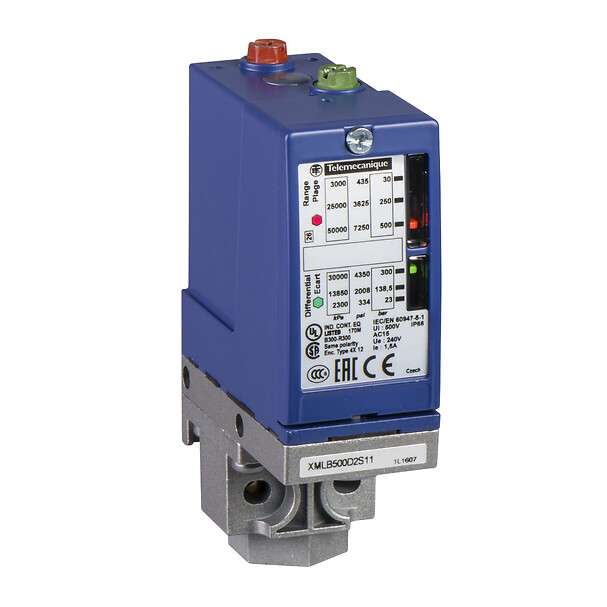
Telemecanique Sensors XMLB300D2S11 Pressure Switch: Electromechanical Threshold Control for Hydraulic Oil Circuits
The Telemecanique Sensors XMLB300D2S11 pressure switch is positioned for hydraulic oil control circuits where the objective is simple and operationally important: switch reliably when pressure crosses a defined point. Many machines do not need continuous analog measurement to run well. They need a clear permission signal—pressure ready, pressure low, or pressure abnormal. In those cases, an electromechanical pressure switch becomes a practical control component that is easy to commission and easy to troubleshoot.
What Telemecanique Sensors XMLB300D2S11 Is Specified For
The Telemecanique Sensors XMLB300D2S11 pressure switch is described as an electromechanical pressure sensor/switch (XMLB family) with controlled fluid listed as hydraulic oil, and it is referenced with a G 1/4 female fluid connection. It is also referenced with Pg 13 cable entry and screw-clamp style electrical termination in product descriptions, which helps define how it is integrated into machine wiring practice.
From a field perspective, these details translate into fast installation and a familiar interface for technicians. When the wiring and the port connection are standard, maintenance is less likely to improvise—and reliability improves.
Why Electromechanical Switching Still Fits Modern Automation
Digital factories still rely on discrete decisions. A pressure switch can act as a “hard gate” that prevents a cylinder from moving if supply pressure is insufficient. It can also protect components: if a lubrication circuit loses pressure, the switch can stop the process immediately.
The Telemecanique Sensors XMLB300D2S11 pressure switch is typically used in these control-centric roles. It supports a direct approach: configure the setpoint, validate behavior, and let the PLC treat it like a dependable digital input.
Port and Mounting Discipline: Small Mistakes Become Chronic Faults
Pressure switches often get blamed for issues that are actually process or installation problems. With a G 1/4 female port, cleanliness matters. Any contamination introduced during installation can migrate into valves or small orifices. Sealing matters as well, because slow leaks can create a situation where the system reaches setpoint in the morning but fails later under load. Those are the faults that waste the most time, because they look “random” until the real cause is found.
Wiring Considerations with Pg 13 Entry
Pg 13 entries help standardize cable glands and routing. The best outcomes come from disciplined cable management: use the correct gland size, apply strain relief, and route cables away from hot surfaces. In hydraulic machines, vibration is a constant. If wiring is allowed to pull on terminals, intermittent signals can appear over time.
When the Telemecanique Sensors XMLB300D2S11 pressure switch is commissioned, it is good practice to gently flex the cable near the gland and verify that the input signal remains stable. If it changes, the fault is usually mechanical at the cable entry rather than inside the switch.
Telemecanique Sensors XMLB300D2S11 Commissioning: Make the Switching Point Meaningful
Setpoint selection should reflect real operating conditions. A common error is choosing a threshold too close to normal operating pressure. That makes the system sensitive to normal fluctuation, and the PLC sees nuisance transitions. Instead, set the threshold where it truly indicates a meaningful condition: a real low-pressure risk or a real pressure-ready confirmation.
Validate with a reference gauge during initial setup. Increase pressure gradually, watch the signal change, and repeat. Repeatability is the performance metric that matters most for a pressure switch used as a control gate.
Maintenance: Let the Switch Tell You a Story
If the switch starts triggering “too early” or “too late,” treat it as a diagnostic signal. Check for regulator drift, pump wear, filter restriction, and leakage. Many times the switch is accurately reporting a system that has changed. Only after confirming stable process conditions should you consider device replacement.
For related options and product family context, see Telemecanique sensor.
FAQ
1) What is Telemecanique Sensors XMLB300D2S11 used for?
It is used to provide a discrete electrical state when hydraulic pressure crosses a defined threshold in control circuits.
2) Which controlled fluid is referenced?
It is referenced for hydraulic oil applications.
3) What connection type is referenced?
It is referenced with a G 1/4 female fluid connection.
4) Why do intermittent signals happen?
Vibration-related wiring strain at the cable entry and process pressure fluctuation are common causes.
5) How should commissioning be validated?
Use a reference gauge, approach the setpoint slowly, and confirm repeatable switching across multiple cycles.