
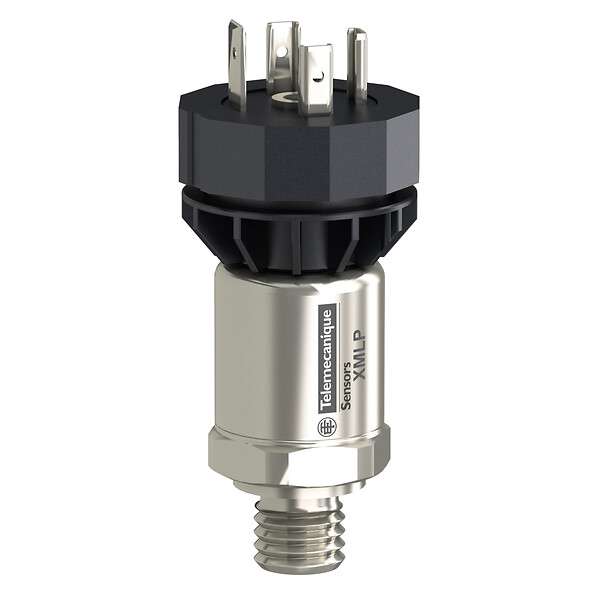
Telemecanique Sensors XMLP010BC21F Pressure Transducer: 0–10 bar with 4–20 mA Output for Industrial Monitoring
The Telemecanique Sensors XMLP010BC21F pressure transducer is an electronic pressure sensor designed for applications where a continuous signal is required rather than a simple on/off threshold. In many machines, threshold switching is enough. In others, operators and control systems need visibility: trending, diagnostics, and precise process control. That is where a 4–20 mA pressure transducer becomes a practical standard—robust over distance, tolerant of electrical noise, and easily interpreted by PLC analog inputs.
What Telemecanique Sensors XMLP010BC21FDelivers
The Telemecanique Sensors XMLP010BC21F pressure transducer is described with a 0–10 bar measurement range, a 4–20 mA output, and a 7–33 VDC supply requirement, along with an IP67 protection rating and operating temperature range references in distributor specifications. This combination is commonly used in industrial environments because it supports stable signal transmission in electrically noisy areas such as motor drives, solenoid valves, and long cable runs.
Why 4–20 mA Still Dominates on the Factory Floor
In real installations, 4–20 mA is valued for predictable behavior under wiring faults. A broken wire often results in a clear signal loss that can be detected in software. The current loop is also less sensitive to voltage drop over long distances compared with voltage-output sensors. For the XMLP010BC21F, this means the transducer can be placed near the pressure source while the PLC can remain in a distant cabinet without sacrificing signal integrity, provided wiring and grounding are done correctly.
Application Examples Where Continuous Pressure Matters
Continuous pressure measurement becomes important in scenarios such as:
- Filter monitoring: rising pressure can indicate clogging before it causes downtime.
- Leak detection: pressure decay trends can reveal leaks that threshold switches may not catch early.
- Process stability: controlling a regulator or pump based on a continuous value improves repeatability.
- Quality consistency: maintaining pressure within a tight band can impact product quality in forming or dispensing.
In these contexts, the Telemecanique Sensors XMLP010BC21F pressure transducer is used not just as a sensor, but as a decision input to analytics, alarms, and closed-loop control.
Installation: Signal Quality Is an Engineering Output
Electronic pressure measurement is often “blamed” when the real issue is installation. A stable result depends on basic discipline:
- Correct wiring: follow the current-loop wiring practice and confirm the analog input configuration.
- Cable routing: keep signal cables separated from high-power lines where possible.
- Grounding strategy: avoid ground loops that introduce measurement noise.
- Mechanical port hygiene: prevent debris from entering the pressure port during installation.
For IP67-rated devices, sealing performance also depends on correct connector/cable practices and protecting the cable from abrasion. IP is not a guarantee if the cable is strained or the connector is not seated correctly.
Commissioning: Turning a Signal into a Reliable Value
Commissioning should validate three things:
- Scaling: confirm PLC scaling matches 0–10 bar and 4–20 mA mapping.
- Stability: verify the signal is steady under normal operation and does not show noise spikes.
- Correlation: compare readings to a reference gauge to confirm system accuracy in the operating range.
If noise appears, investigate cable routing and grounding first. If the value drifts, investigate process temperature and pressure pulsation. Many plants solve stability by adding mechanical damping or relocating the sensing point away from sharp pressure pulses.
For related Telemecanique options and product families, visit Telemecanique sensor.
Telemecanique Sensors XMLP010BC21F FAQ
1) What is Telemecanique Sensors XMLP010BC21F?
It is an electronic pressure transducer providing a continuous signal for industrial monitoring and control.
2) What range is associated with this reference?
It is described with a 0–10 bar measurement range.
3) What output does it provide?
It is described with a 4–20 mA output signal.
4) What supply range is referenced?
Distributor specifications reference 7–33 VDC supply.
5) What causes unstable readings most often?
Poor cable routing, grounding issues, and pressure pulsation near valves or pumps are common causes of instability.