
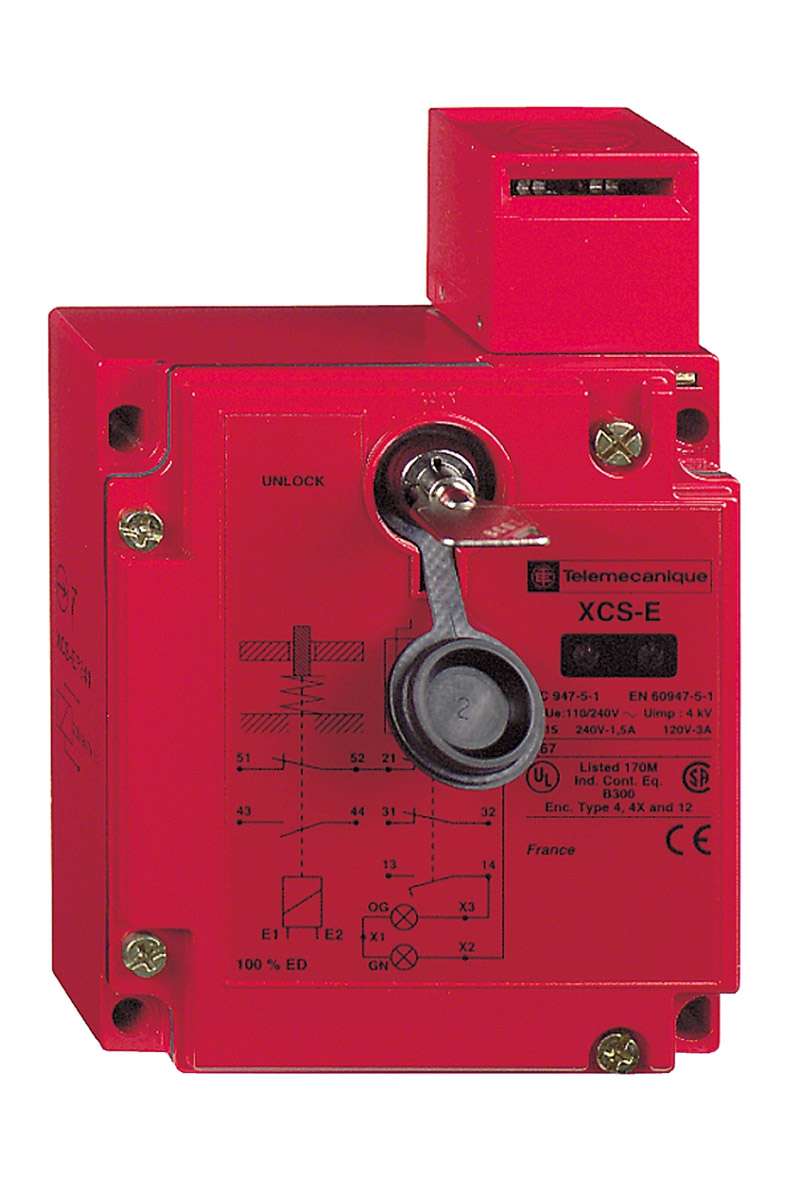
Telemecanique Sensors XCSE5311 Solenoid Interlock Safety Switch: Controlled Access with Bolting and 24 V Supply
The Telemecanique Sensors XCSE5311 solenoid interlock safety switch is designed for guard door applications where the machine needs not only to detect the door position, but also to manage access in a controlled way. XCSE devices are commonly used in automation cells where a guard should remain closed until motion has stopped, or where the control system needs to prevent the door from opening during a hazardous phase.
Telemecanique Sensors XCSE5311Why Solenoid Interlocks Are Chosen
In many facilities, the safety challenge is not “Can we detect an open door?” but “Can we ensure the door stays closed while the machine is still dangerous?” A solenoid interlock addresses that requirement by adding a locking/bolting function to the interlock concept. The result is a guard system that supports disciplined access control: operators can enter only when the control system allows it.
This approach is widely used in:
- Robotic cells where residual motion exists after stop command
- High-inertia machines that need time to come to rest
- Automated lines where unexpected access could create a hazard
- Processes where opening a guard mid-cycle can damage tooling or product
Key Technical Traits of Telemecanique Sensors XCSE5311
Distributor specifications describe XCSE5311 as a safety switch in the XCSE family with a 24 V DC supply, metal housing, and IP67 protection. Some listings also reference a high holding force level in the XCSE bolting concept, reflecting the expectation that the locking mechanism withstands practical door forces in an industrial setting.
From a machine design perspective, 24 V supply aligns with common control cabinet standards. IP67 and metal construction are frequently selected when the interlock is mounted in areas exposed to washdown, dust, or aggressive cleaning routines, as long as installation practices are correct.
Telemecanique Sensors XCSE5311 Installation: Alignment Is Everything
Solenoid interlocks do not tolerate poor mechanical alignment. If a guard door sags over time, the actuator can enter the head at an angle. That can cause nuisance faults, failure to lock, or accelerated wear. A reliable installation typically includes:
- Rigid door hinges and stable frame: reduce long-term sag.
- Correct actuator approach: the actuator should enter smoothly without rubbing.
- Controlled closing motion: avoid slamming the door, which can loosen fasteners.
During commissioning, close the door slowly and observe: does the actuator engage consistently, does the lock sequence behave predictably, and does the feedback state remain stable? If behavior varies, fix the mechanics first.
Electrical Integration and Commissioning Discipline
Solenoid interlocks can be misunderstood if the wiring and logic expectations are not documented clearly. The control system must define what conditions permit unlocking and what conditions require locking. In practice, commissioning teams should verify:
- Correct supply voltage under load
- Stable wiring terminations and protected cable routing
- Consistent door-closed feedback states
- Predictable lock/unlock behavior aligned with the machine sequence
A simple but effective practice is to test access control during realistic scenarios: emergency stop recovery, power cycle, and end-of-cycle stop. These are the moments when access logic errors tend to appear.
Maintenance: Preventing Avoidable Downtime
The most common field issues are mechanical, not electrical. If the interlock begins to fault intermittently, look for hinge wear, actuator looseness, and door misalignment. Cleaning teams can also accidentally bend actuator brackets or loosen screws. Quick periodic checks often prevent unplanned stoppages.
For related products and a broader overview, visit Telemecanique sensor.
Telemecanique Sensors XCSE5311 FAQ
1) What is the main purpose of XCSE5311?
It is intended for guard monitoring with a bolting/locking concept to help control access during hazardous machine states.
2) What supply voltage is commonly referenced?
Listings for XCSE5311 reference a 24 V DC supply.
3) What enclosure and protection level are indicated?
It is commonly referenced with a metal housing and IP67 protection in distributor specifications.
4) What is the biggest installation risk?
Misalignment caused by door sag or poor actuator approach is the most common cause of nuisance faults.
5) What should be tested during commissioning?
Verify stable door-closed detection, predictable lock/unlock behavior, and correct function during power cycle and stop conditions.