
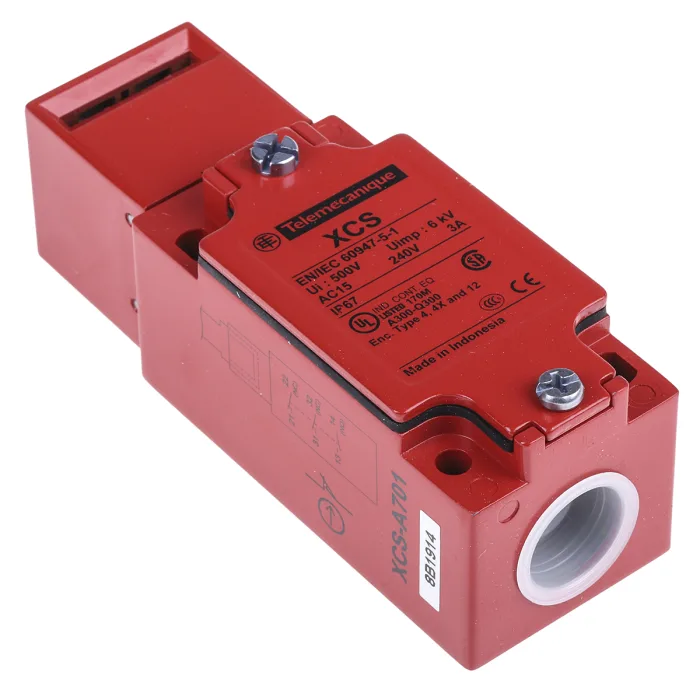
Telemecanique Sensors XCSA701 Safety Interlock Switch: Key-Operated 2NC+1NO Interlock for Industrial Guards
The Telemecanique Sensors XCSA701 safety interlock switch is part of the Telemecanique Safety switches XCS range in the metal XCSA design. Distributor references describe XCSA701 as a non-locking interlock with 2 NC + 1 NO contact composition.
Functional Purpose in Machine Guarding
Key-operated safety interlocks are widely used where a machine must know whether a guard is closed before allowing motion, or where motion must stop when a guard is opened. The interlock provides a clear electrical state change based on physical engagement of an actuator key.
In practical engineering terms, the interlock is only as reliable as its mechanical alignment. A perfectly specified contact set cannot compensate for a door that sags over time or an actuator that approaches at an angle. This is why installation and mechanical maintenance are central to long-term performance for the Telemecanique Sensors XCSA701 safety interlock switch.
Contacts: Why 2NC+1NO Is a Common Choice
Listings describe XCSA701 with 2 NC + 1 NO. (DigiKey and TME references)
In real control cabinets, engineers often use NC channels as the primary monitored paths because an open circuit can be detected as a fault state. The NO channel can be used for indication or secondary logic. The exact safety architecture depends on the machine design and applicable standards, but from a day-to-day maintenance viewpoint, the advantage of multiple channels is clearer diagnostics when something does not behave as expected.
Housing, Sealing, and Field Reality
TME describes Telemecanique Sensors XCSA701 as a metal safety switch and lists IP67 in its product category description.
IP performance depends on correct cable-gland installation and strain relief. Many sealing issues are created during installation: the wrong cable diameter, jacket damage, insufficient tightening, or cable pull that gradually loosens the gland. In guard-door applications, cables are often routed through moving hinges or flexible conduits, so strain relief should be treated as an engineering deliverable, not an afterthought.
Telemecanique Sensors XCSA701 Mechanical Installation: Alignment, Door Sag, and Repeatability
Key-operated interlocks require a straight, consistent key insertion path. Reliability improves when:
- Hinges are stable and maintained: sag changes the insertion geometry and causes rubbing.
- Actuator mounting is rigid: thin brackets can flex and drift during repeated door cycles.
- Closing force is controlled: slamming a door can accelerate wear and loosen fasteners.
A practical commissioning test is to close the guard slowly and observe whether the signal transitions cleanly at the same point each time. If the state change varies, treat it as a mechanical alignment issue first.
Telemecanique Sensors XCSA701 Wiring Documentation: Preventing Downtime Through Clarity
Interlocks often fail operationally not because they are broken, but because wiring changes over time and documentation lags behind. A disciplined approach is to:
- Label each contact channel in the panel and on the drawings
- Record which PLC input corresponds to each contact path
- Define the expected logic state for “guard closed” and “guard open”
That documentation reduces troubleshooting time during production interruptions, especially when multiple interlocks are installed across a line.
For broader product family alignment and related options, visit Telemecanique sensor.
Telemecanique Sensors XCSA701 FAQ
1) What contact composition is associated with XCSA701?
Listings describe it as 2 NC + 1 NO.
2) Is it described as non-locking?
DigiKey classifies XCSA701 as a non-locking interlock device.
3) What protection level is indicated by some listings?
TME lists IP67 in its product description for XCSA701.
4) What is the most common mechanical issue in the field?
Door sag and actuator misalignment are frequent root causes of intermittent states in key-operated interlocks.
5) What installation habit prevents many failures?
Proper strain relief and correct gland/cable matching prevent loosening and sealing problems over time.