
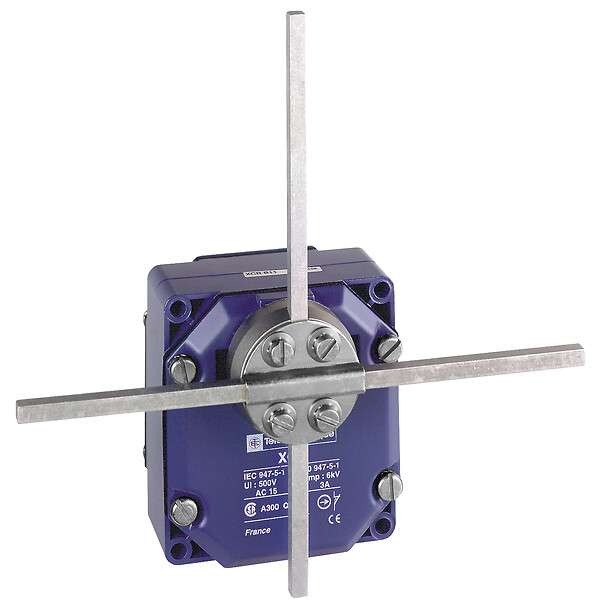
Telemecanique Sensors XCRF57 Limit Switch: Cross Lever Rotary Head Design for Hoisting Applications
The Telemecanique Sensors XCRF57 limit switch is associated with the Osisense XC family and is commonly referenced in the context of cross lever switches for hoisting applications. Schneider Electric’s FAQ on CAD availability explicitly lists XCRF57 among the standard references in the XCRF cross lever series intended for hoisting-related use.
Telemecanique Sensors XCRF57 What a Cross Lever Switch Solves in Hoisting Mechanisms
Hoisting systems often require position confirmation where approach direction may vary due to rope sway, load movement, or mechanical tolerances in the carriage. A cross lever concept can help because it provides multiple engagement directions: instead of forcing a single precise cam strike, the mechanism can contact the lever from different angles while still producing a switching event. This is one reason cross lever styles are frequently used as travel limit detection on lifting, crane, and handling equipment.
The key engineering objective in these systems is not micro-positioning; it is dependable state change under real mechanical variation. The Telemecanique Sensors XCRF57 limit switch fits that philosophy as a robust mechanical detector where contact is physical and observable.
Mechanical Construction and Industrial Robustness
Distribution references list XCRF57 as a Telemecanique limit switch and associate it with the XCR line. For example, Mouser lists XCRF57 as a limit switch with typical industrial ratings and provides a datasheet link for deeper specification review.
In practical terms, metal-bodied XC switches are chosen to tolerate vibration and occasional impacts better than purely plastic enclosures. In hoisting environments, vibration and dynamic loads are normal, so mounting rigidity and mechanical clearance planning are as important as the switch itself.
Telemecanique Sensors XCRF57 Wiring Entry and Installation Discipline
Hoisting equipment is often serviced under time pressure, so wiring discipline matters. Cross lever limit switches in the XCR family are commonly associated with Pg 13.5 cable-gland practices in related CAD references and series descriptions.
From a field perspective, the most reliable installations share these traits:
- Consistent actuator engagement: the moving striker should contact the lever reliably through the full range of travel variation.
- Rigid mounting: bracket flex can shift actuation points and create nuisance trips.
- Protected cable routing: hoisting motion and vibration can fatigue cables if strain relief is weak.
Commissioning Approach: Prove Behavior Under Load, Not Only Unloaded
A hoist behaves differently loaded vs unloaded. Commissioning should include tests at representative loads because rope tension, braking behavior, and carriage movement can change the approach path to the actuator. The practical goal is to ensure the switch trips at the correct travel limit with enough mechanical margin that it does not hover near the switching threshold.
Operational Use and Maintenance Mindset
For long-term reliability, maintenance teams typically focus on the actuator interface: look for wear grooves, bent lever elements, and striker misalignment. Electrical issues are less common than mechanical ones in well-installed limit switches. If intermittent signals appear, the first check is usually: is the lever being contacted consistently with adequate travel?
For additional related sensing solutions and standardized selection across projects, visit Telemecanique sensor.
Telemecanique Sensors XCRF57 FAQ
1) Is Telemecanique Sensors Telemecanique Sensors XCRF57 referenced for hoisting applications?
Yes. Schneider Electric’s FAQ about cross lever switches for hoisting lists XCRF57 among the covered standard references.
2) Why use a cross lever style?
It can tolerate approach variation by allowing engagement from multiple directions, which is helpful in dynamic hoisting mechanisms.
3) Where can technical documents be found?
Distributor pages such as Mouser provide the datasheet link for XCRF57.
4) What is the most common reliability risk?
Mechanical misalignment or insufficient travel margin at the lever is a frequent root cause of intermittent trips.
5) What commissioning test is often overlooked?
Testing with representative load conditions; loaded behavior can change the approach and trip margin.