
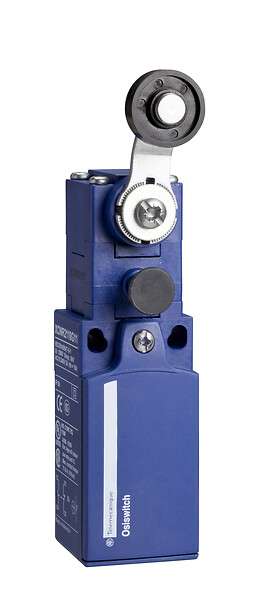
Telemecanique Sensors XCNR2118P20 Limit Switch: Roller Lever DPST NO/NC with M20 Cable Entry
The Telemecanique Sensors XCNR2118P20 limit switch is used for mechanical position feedback in industrial automation where a cam or moving part can sweep across a lever. In distribution references, XCNR2118P20 is described as a chassis-mount switch with DPST-NO/NC contact behavior, which aligns with a paired NO and NC function for discrete control logic.
Mechanical Role: Why Roller Lever Switching Is Still Relevant
Even in plants with extensive proximity sensing, roller lever limit switches remain relevant because they are straightforward to diagnose. If a station fails to confirm position, the technician can observe the cam and actuator physically, rather than chasing fieldbus messages or analog thresholds. This is especially valuable in dusty environments or on non-metallic targets where inductive sensing is not ideal.
With the Telemecanique Sensors XCNR2118P20 limit switch, the roller lever interface is designed to support repeated cam engagement. Rolling contact typically reduces friction at the actuation point compared with a sliding striker, helping stabilize the trip behavior over long cycles when the cam surface is smooth and the bracket is rigid.
Contact System and Control Logic Implications
DPST NO/NC descriptions in distributor listings indicate two poles switching, providing both a normally open and normally closed state for control design. In PLC architectures, that can be used to support either event confirmation (NO closes at position) or continuity monitoring (NC opens at position), depending on how the program is structured.
For commissioning clarity, teams usually standardize: choose one signal as the “truth” input to the PLC and keep the other contact as an auxiliary for diagnostics or interlocks. This avoids conflicting logic when both contacts are wired but only one is properly documented.
Telemecanique Sensors XCNR2118P20 Cable Entry and Field Wiring Discipline
The “P20” designation in XC family references commonly corresponds to an M20 cable entry approach used across similar XC compact models. In real installations, what matters is that cable gland selection matches cable outer diameter, that the gland is tightened properly, and that strain relief prevents the cable from pulling on the terminals during vibration or maintenance work.
Because limit switches are often installed near moving parts, good wiring discipline is a reliability multiplier: route the cable away from pinch points, avoid sharp bends near the gland, and ensure the cable jacket is not damaged when passing through machine guards.
Telemecanique Sensors XCNR2118P20 Typical Application Areas
- Conveyor diverter confirmation
- Transfer station “home” detection
- Packaging machine cam sequencing
- Material handling stops and end-of-travel checks
In each of these cases, the goal is not “precision measurement,” but a stable, repeatable state change at a defined mechanical position. A roller lever limit switch is well suited to that objective when cam geometry is controlled.
Telemecanique Sensors XCNR2118P20 Common Failure Modes and How to Prevent Them
- Intermittent switching: often caused by insufficient travel past the switching threshold; fix cam profile or alignment.
- Premature wear: often caused by sharp cam edges or excessive overtravel force; smooth and control the cam interface.
- Sealing issues: usually due to incorrect gland selection or poor strain relief; verify installation hardware and torque practice.
For a broader view of compatible sensing solutions and selection consistency, visit Telemecanique sensör.
Telemecanique Sensors XCNR2118P20 FAQ
1) What contact behavior is associated with XCNR2118P20?
Distributor references describe XCNR2118P20 as DPST-NO/NC.
2) Why is a roller lever helpful?
Rolling contact can reduce friction at the cam interface and support stable, repeatable actuation when cam surfaces are smooth.
3) What is the most common commissioning mistake?
Setting the cam so it barely reaches the switching point; the mechanism should move confidently through the switching region.
4) What should be prioritized in wiring?
Correct gland selection, strain relief, and routing away from pinch points are key to long-term reliability.
5) Where is this type of switch typically used?
It is commonly used for end-of-travel and sequence confirmation on conveyors, transfer systems, and cam-driven stations.