
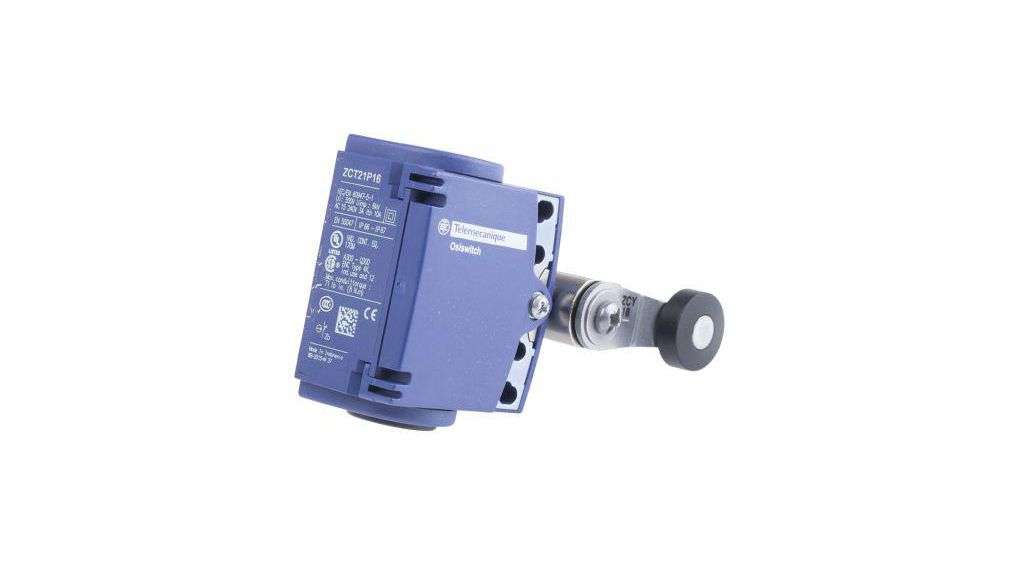
Telemecanique Sensors XCKT2118P16 Limit Switch: Rotary Head Thermoplastic Roller Lever for Lateral Cam Actuation
The Telemecanique Sensors XCKT2118P16 limit switch is a compact XC Standard device engineered for repeatable cam-based position detection in industrial automation. This model uses a rotary head and a spring return thermoplastic roller lever, supports lateral approach in two directions, and provides a 1 NC + 1 NO contact set with snap action switching. Its connection concept includes two M16 x 1.5 cable entries and screw-clamp terminals, enabling practical machine wiring layouts.
Telemecanique Sensors XCKT2118P16 Mechanical Configuration and the Role of the Rotary Head
In the XC Standard compact design, a rotary head is typically chosen when the mechanical actuator interface is best served by a lever or roller that rotates with engagement. For XCKT2118P16, the operating head movement is specified as rotary, matching the roller lever actuation concept. This helps the switch follow the cam path smoothly, especially when the cam approaches laterally and the machine geometry requires the actuator to “sweep” rather than compress linearly.
Because the approach is listed as lateral, two directions, this device is often convenient in modular machine design. A single switch type can be used in mirrored stations or in layouts where the cam can approach from either side—provided the mounting bracket and cam placement are set up consistently.
Contacts, Positive Opening, and Switching Quality
The 1 NC + 1 NO configuration with snap action supports clear discrete signaling. The datasheet indicates positive opening: with, which is relevant when designers want a mechanically enforced opening behavior on NC contacts under defined conditions. In control logic terms, snap action delivers a fast transition that tends to read cleanly on PLC inputs.
Actuation by 30° Cam and Torque Parameters
The switch is specified for actuation by 30° cam. This is a widely used industrial approach because it can create a controlled actuation profile with predictable overtravel. The datasheet provides useful torque guidance: minimum torque for tripping and positive opening minimum torque values are specified, which helps engineers validate cam leverage and ensure consistent engagement without overstressing the mechanism. Maximum actuation speed is also specified, supporting use in faster-moving machine cycles when the cam profile is correct.
Wiring, Cable Entry, and Electrical Ratings Context
The Telemecanique Sensors XCKT2118P16 uses screw-clamp terminals and two M16 x 1.5 tapped cable entries, with cable diameter range stated in the datasheet. Repeat accuracy is specified as 0.1 mm on tripping points with 1 million operating cycles, which supports stable timing for sequencing tasks such as indexing confirmation, diverter positioning, and station-in-place detection. Contact code designations such as A300 (AC-15) and Q300 (DC-13) are also listed to frame typical industrial control loads under standard categories.
Telemecanique Sensors XCKT2118P16 Environmental Protection and Durability
For industrial environments, the model lists IP66 and IP67 protection, plus shock and vibration resistance values and a mechanical durability figure. These characteristics are meaningful in practice only when installation discipline is maintained: select the correct glands, avoid jacket damage, and ensure the body is mounted on a rigid surface to protect repeatability.
For additional related sensor solutions, review Telemecanique sensor.
Telemecanique Sensors XCKT2118P16 FAQ
1) What actuator style does Telemecanique Sensors XCKT2118P16 use?
It uses a spring return thermoplastic roller lever with a rotary head.
2) Telemecanique Sensors XCKT2118P16 What approach direction is supported?
Lateral approach in two directions is specified.
3) What contact configuration is included?
It provides 1 NC + 1 NO contacts with snap-action operation.
4) Telemecanique Sensors XCKT2118P16 What cable entry does it use?
It is specified with two M16 x 1.5 tapped cable entries.
5) Is repeatability specified for long cycle life?
Yes—repeat accuracy is specified as 0.1 mm on tripping points with 1 million operating cycles.