
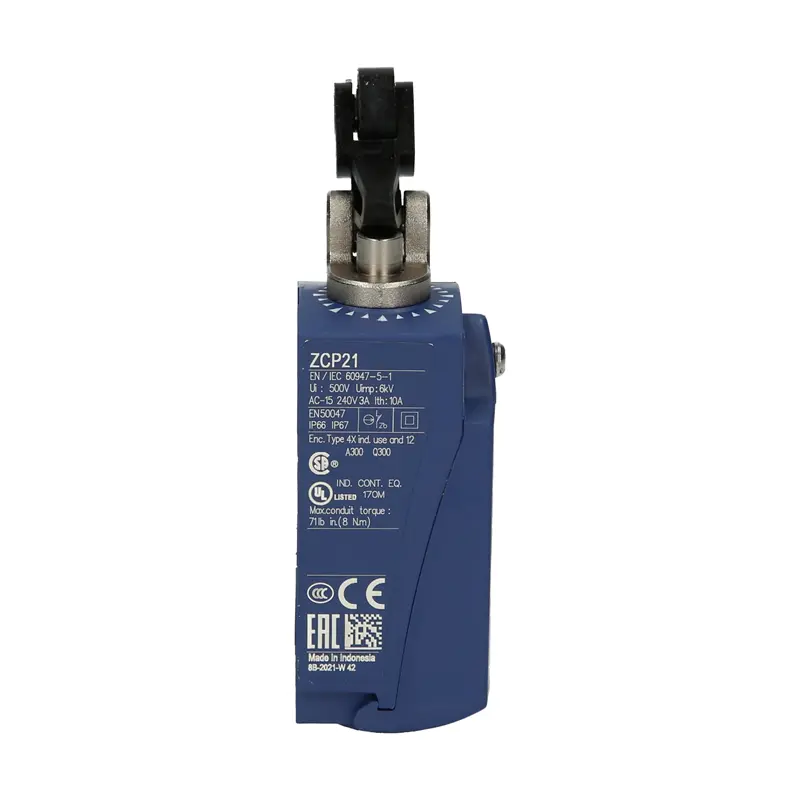
Telemecanique Sensors XCKP2127P16 Limit Switch: Modular Compact Switch with Thermoplastic Roller Lever Plunger
The Telemecanique Sensors XCKP2127P16 limit switch is an XC Standard compact device designed for mechanical position detection in industrial automation where serviceability and consistent switching are required. This model is defined as a limit switch with a spring return roller lever plunger (thermoplastic), 1 NC + 1 NO contacts, snap action operation, and an M16 x 1.5 cable gland entry.
Unlike purely electronic proximity solutions, a limit switch provides a direct mechanical interface that is easy to understand, diagnose, and replace. In maintenance-driven environments—packaging lines, material handling, or assembly stations—the Telemecanique Sensors XCKP2127P16 limit switch is typically chosen because it integrates cleanly into standard cam/striker geometry and delivers a clear NC/NO state for PLC inputs.
Telemecanique Sensors XCKP2127P16 Device Format and Mechanical Behavior
The device short name is listed as XCKP, within Telemecanique Limit switches XC Standard, in a compact sensor design. It uses a fixed body and a plunger head with linear operating head movement. The actuator is a spring return roller lever plunger thermoplastic, which is helpful when a cam profile approaches vertically and needs rolling contact rather than sliding contact for smoother engagement.
The approach type is specified as vertical approach, 1 direction. In practical machine layouts, this informs how to position the cam so it presses the actuator consistently from the intended direction. If the striker hits from the side, lever loading changes, which can shift the switching point and create avoidable wear.
Contacts and Switching Quality
The Telemecanique Sensors XCKP2127P16 limit switch provides 1 NC + 1 NO contacts with snap action operation. This combination is widely used for discrete control logic: NC can serve as a “healthy/closed” signal in some architectures, while NO can be used for event confirmation. Snap action improves electrical decisiveness, especially in slow or variable-speed mechanisms.
Actuation by Cam and Repeatability
The switch actuation is specified as by 30° cam. This encourages a controlled engagement geometry rather than a blunt impact. Repeat accuracy is specified as 0.1 mm on the tripping points with 1 million operating cycles. In operational terms, that repeatability supports stable timing and consistent machine sequencing across long production runs, provided the cam profile and mounting remain rigid.
Wiring, Cable Entry, and Field Service
The device uses screw-clamp terminals with clamping capacity 1 x 0.34…2 x 1.5 mm².Cable entry is specified as 1 entry tapped for M16 x 1.5 cable gland, with cable outer diameter 4–8 mm. These parameters are essential for maintaining sealing integrity and strain relief. If the cable is too small, the gland may not seal properly; if too large, the jacket can be damaged and the entry can leak.
Industrial contact duty categories include A300 / AC-15 and Q300 / DC-13 (including examples such as Ue 240 V, Ie 3 A, Ithe 10 A). This helps engineering teams map the switch to appropriate control loads under standard definitions.
Environmental Protection
The Telemecanique Sensors XCKP2127P16 limit switch is listed with IP66 and IP67 protection ratings, and IK04 impact rating, with shock and vibration resistance figures referenced to IEC methods. These values support use in washdown-adjacent or dusty environments when installation practices are disciplined: correct gland selection, correct cable diameter, and a clean mating surface.
For consistent selection across sensor families and machine projects, review Telemecanique sensor.
Telemecanique Sensors XCKP2127P16 FAQ
1) What actuator does XCKP2127P16 use?
It uses a spring return thermoplastic roller lever plunger with linear movement.
2) What contacts are included?
It provides 1 NC + 1 NO contacts with snap action operation.
3) What cable entry is specified?
It uses 1 tapped entry for M16 x 1.5 cable gland, cable diameter 4–8 mm.
4) What repeatability is specified?
Repeat accuracy is specified as 0.1 mm on tripping points with 1 million operating cycles.
5) What protection ratings are listed?
It is listed with IP66 and IP67 protection ratings.