
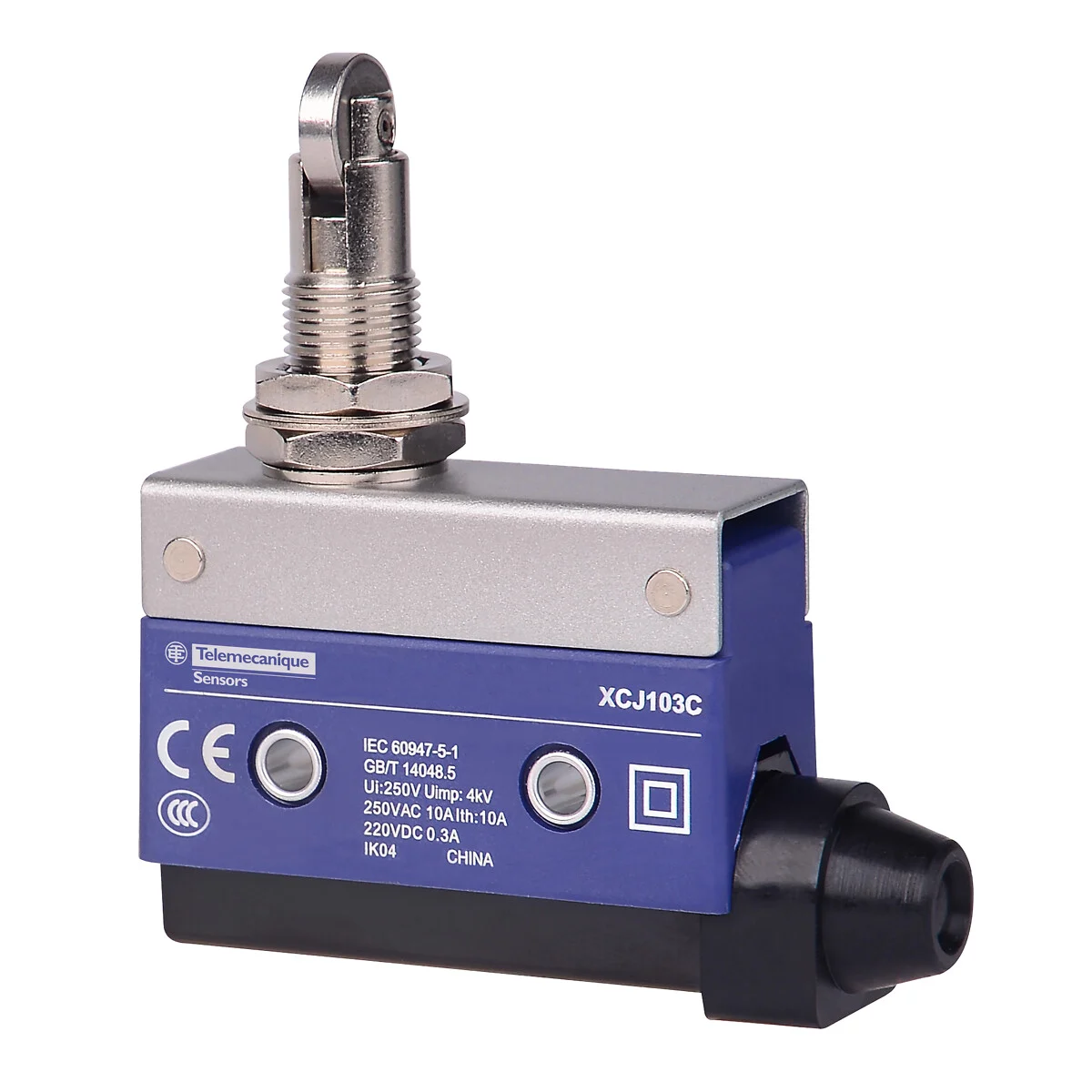
Telemecanique Sensors XCJ127C Limit Switch: Short Flat Roller Lever Plunger for Lateral Approach
The Telemecanique Sensors XCJ127C limit switch is a cam-friendly mechanical position switch used in light to medium duty automation. Its actuator is a roller lever plunger in thermoplastic that is short and flat, enabling smooth engagement by a cam surface. The device is designed for lateral approach in one direction and typically actuates by a 30° cam, supporting repeatable machine feedback in compact assemblies.
Engineers frequently select lever-and-roller actuators when they want controlled contact, reduced friction at the actuation point, and a stable trip profile over repeated cycles. With snap-action switching and practical screw-clamp terminals, the Telemecanique Sensors XCJ127C limit switch fits neatly into standard PLC input architectures.
What XCJ127C Is Optimized For
XCJ127C is well suited to side engagement where a moving cam plate passes a fixed sensor location. Compared with a vertical plunger strike, lateral actuation can simplify mechanical packaging—especially when the machine already includes a cam surface that can be extended slightly to contact the roller.
For structured naming and searchability inside engineering records, many teams consistently refer to the device as Telemecanique Sensors XCJ127C limit switch.
Technical Characteristics
- Product type: Limit switch (light to medium duty)
- Body type: Fixed
- Head type: Plunger head with linear operating head movement
- Actuator: Roller lever plunger thermoplastic, short and flat
- Switch actuation: By 30° cam
- Approach: Lateral approach, 1 direction
- Contact operation: Snap action
- Electrical connection: Screw-clamp terminals
- Cable entry: Flexible rubber cable gland (typical outer diameter 8.5–10.5 mm)
- Protection: IP40
- Design references: A300 (AC) and R300 (DC) rating families are commonly used in selection context
Practical Applications
The Telemecanique Sensors XCJ127C limit switch is frequently used in:
- Cam-driven packaging stations where a moving plate confirms position
- Small conveyors where a diverter arm passes a sensor point laterally
- Indexing mechanisms that need a stable “position achieved” feedback signal
- Transfer modules where lateral engagement reduces mounting complexity
In these systems, the roller can reduce friction between the cam and actuator, which may improve consistency over long production runs—especially when the cam face is smooth and engagement occurs at a controlled speed.
Mechanical Integration Notes
For reliable operation, treat cam design and mounting as a combined discipline:
- Cam surface quality: Smooth surfaces help the roller maintain stable contact and reduce wear.
- Engagement depth: Ensure the cam provides sufficient travel to reach a stable switched state.
- Bracket stiffness: A flexible bracket can shift the actuation point and create inconsistent switching.
- Overtravel management: Avoid excessive force beyond intended travel; it can reduce repeatability over time.
If you are aligning plant-wide standards, consider reviewing related sensor solutions via Telemecanique sensor to keep actuator behaviors consistent across machine families.
Electrical Wiring and Signal Robustness
The Telemecanique Sensors XCJ127C limit switch is typically wired into discrete inputs using screw-clamp terminals. To reduce downtime risk:
- Ensure solid termination: Properly tightened terminals and good conductor prep prevent intermittent faults.
- Protect against cable strain: Route cables to avoid pulling on the gland during maintenance access.
- Use PLC filtering if needed: If a cam dwells near the trip point during vibration, debounce can prevent flicker.
Maintenance and Troubleshooting
During preventive checks, inspect the roller and lever for wear, verify the cam still contacts the actuator at the intended position, and confirm switching repeatability. If the Telemecanique Sensors XCJ127C limit switch becomes inconsistent, the most common mechanical causes include cam misalignment, bracket loosening, or insufficient actuation depth.
FAQ
1) What type of actuator does XCJ127C use?
XCJ127C uses a short, flat thermoplastic roller lever plunger designed for cam engagement.
2) What approach direction is intended?
It supports lateral approach in one direction and typically actuates by a 30° cam.
3) Why use a roller lever with a cam?
The roller can reduce friction and support smooth engagement, helping maintain consistent switching behavior.
4) How is the device commonly connected electrically?
It uses screw-clamp terminals with a cable gland entry suitable for typical industrial cabling.
5) What should be checked first when switching is inconsistent?
Check cam alignment, engagement depth, and mounting rigidity; mechanical factors are the most common root causes.