
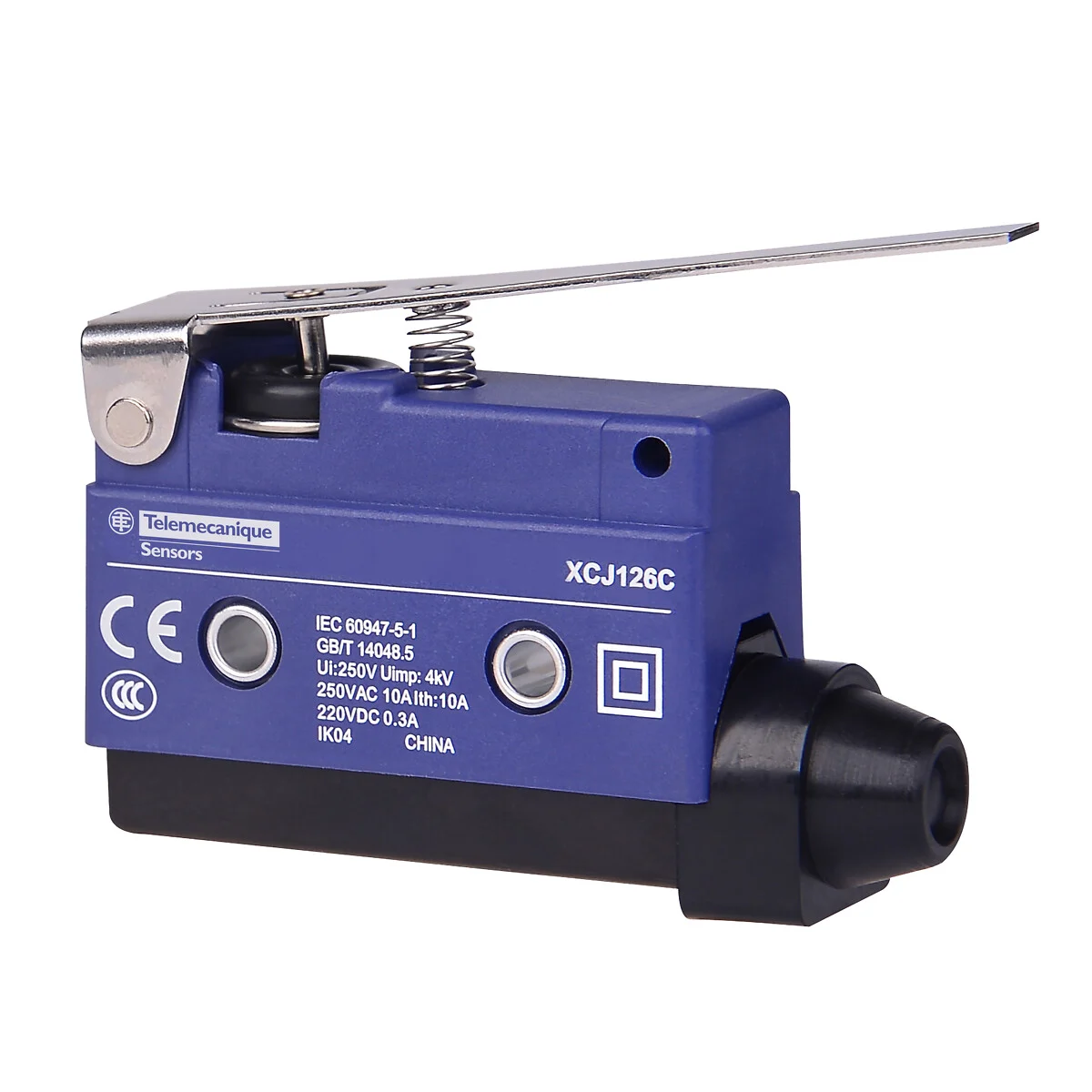
Telemecanique Sensors XCJ121C Limit Switch: Short Flat Lever Roller End Plunger for One-Side Actuation
The Telemecanique Sensors XCJ121C limit switch is engineered for light to medium duty automation where a lateral approach and lever-style actuation provide practical advantages. Instead of a pure vertical strike on a plunger, the XCJ121C uses a roller lever plunger in thermoplastic with a short, flat, retractable lever. This structure allows a cam or moving surface to engage the roller with controlled mechanical contact, frequently improving repeatability in compact mechanisms.
In equipment such as packaging lines, small conveyors, or indexing stations, designers often need a reliable “position reached” signal without adding complexity. The Telemecanique Sensors XCJ121C limit switch fulfills that role by combining snap-action switching with a lever-and-roller interface that is well suited to cam-driven motion.
Defining Features of XCJ121C
XCJ121C is characterized by switch actuation by 30° cam and a lateral approach in 2 directions. That means the actuator can be engaged from the side, and the geometry supports practical cam designs that sweep across the roller. For many machine layouts, a lateral approach is easier to package than a vertical strike—especially when a moving plate or carriage already travels past the sensor location.
When you standardize terminology across procurement and maintenance, it is helpful to consistently label the device as Telemecanique Sensors XCJ121C limit switch in parts lists and wiring diagrams.
Technical Characteristics Summary
- Product type: Limit switch (light to medium duty)
- Device family: XCJ Basic format
- Body type: Fixed
- Head type: Plunger head with linear operating head movement
- Actuator: Roller lever plunger, thermoplastic, short and flat, retractable
- Actuation: By 30° cam
- Approach: Lateral approach, 2 directions
- Contacts: Snap action behavior for crisp switching
- Electrical connection: Screw-clamp terminals
- Cable entry: Flexible rubber cable gland (typical outer diameter 8.5–10.5 mm)
- Protection: IP40
- Environmental robustness context: Shock and vibration references are commonly used during design validation
Where XCJ121C Performs Best
The Telemecanique Sensors XCJ121C limit switch is commonly applied when a cam can sweep across a roller. Typical use cases include:
- Indexing tables where a cam plate triggers a position confirmation signal
- Light conveyor diverters and stops where side engagement is natural
- Packaging mechanisms where a retractable lever reduces the risk of snagging
- Transfer stations where travel is consistent and a two-direction lateral approach is useful
This actuator style can reduce friction compared with a direct plunger strike, especially when a cam surface slides along the roller. In many designs, that contributes to stable switching points over repeated cycles.
Mechanical Design Considerations
To extract consistent performance from the Telemecanique Sensors XCJ121C limit switch, treat the cam profile and mounting as a matched system:
- Cam geometry: Use a smooth cam surface to engage the roller without abrupt impacts.
- Trip repeatability: Ensure the cam reaches the same engagement depth cycle-to-cycle.
- Side load control: Avoid forcing the lever beyond intended travel; excessive overtravel can reduce lifecycle stability.
- Mounting rigidity: A small bracket deflection can shift the actuation point, so mount on a stable frame member.
If you are building a broader sensor standard for a facility, review your family options under Telemecanique sensor to keep a consistent approach across machines and spares.
Electrical Integration and Signal Quality
The Telemecanique Sensors XCJ121C limit switch interfaces cleanly with standard discrete inputs. Snap-action contacts are particularly useful in cam applications because the transition from one state to the other is fast, reducing the chance of ambiguous intermediate states. For best signal quality:
- Route cables cleanly: Prevent mechanical strain at the gland and ensure safe bend radius.
- Apply input filtering if required: In high-vibration environments, PLC debounce can reduce nuisance transitions.
- Maintain clear labeling: Document wiring states and test points so troubleshooting stays efficient.
Maintenance and Practical Troubleshooting
Mechanical switches are often preferred because troubleshooting is direct: check the actuator motion, then verify the electrical state change. During preventive maintenance for the Telemecanique Sensors XCJ121C limit switch, inspect the roller for wear, ensure the lever retracts smoothly, and confirm the cam still meets the roller as designed. If the input signal becomes intermittent, start by checking bracket tightness and cam alignment before suspecting the switch itself.
Telemecanique Sensors XCJ121C FAQ
1) What makes XCJ121C different from a vertical plunger limit switch?
XCJ121C is designed for lateral approach and cam-driven actuation via a short flat lever with a roller end.
2) Can the actuator be approached from more than one direction?
Yes. XCJ121C supports lateral approach in two directions, which can simplify cam layouts.
3) Why use a roller lever for cam actuation?
The roller reduces friction at the interface, supporting smoother engagement and consistent trip behavior.
4) How is the switch typically wired?
It uses screw-clamp terminals, which are common for field wiring and maintenance access.
5) What is a common field issue with lever-based limit switches?
Misaligned cams or bracket flex can shift the trip point. Mechanical alignment checks usually solve the problem.