
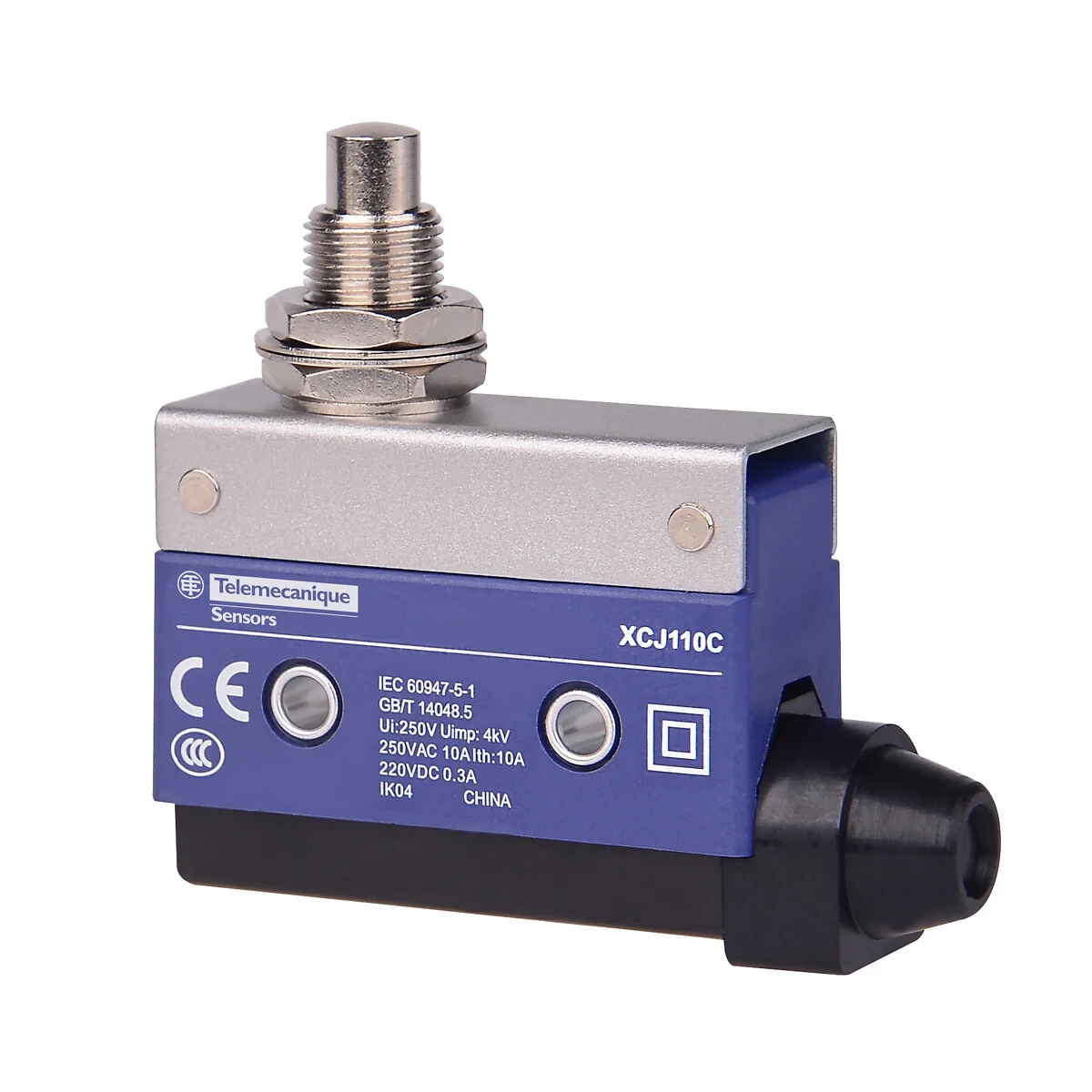
Telemecanique Sensors XCJ102C Limit Switch: Horizontal Steel Roller Plunger for Space-Efficient Detection
The Telemecanique Sensors XCJ102C limit switch is an OsiSense XC Basic series device designed for light to medium-duty position feedback with a plunger head and a spring return stainless-steel roller plunger optimized for horizontal (lateral) actuation. This makes Telemecanique XCJ102C limit switch particularly relevant in compact assemblies where a side approach is the only feasible mechanical path, and where a roller-tipped plunger helps manage contact friction and cam interaction.
Brand + Code + Product Type Variations
In standard naming patterns you will see Telemecanique Sensors XCJ102C limit switch, Telemecanique XCJ102C limit switch, and Telemecanique Sensors XCJ102C roller plunger limit switch. These “brand + product code + product type” variants are useful because the XC family contains multiple actuator geometries that look similar at a glance but behave differently in motion design.
Technical Characteristics (Telemecanique Sensors XCJ102C)
- Range / Series: OsiSense XC, Basic
- Product type: Limit switch; Application: Light to medium duty
- Device short name: XCJ; Body type: Fixed
- Head type: Plunger head; Movement: Linear
- Operator type: Spring return roller plunger (stainless steel)
- Switch actuation: On end; Approach: Lateral approach, 1 direction
- Electrical connection: Screw-clamp terminals
- Cable entry: Flexible rubber cable gland; cable OD 8.5–10.5 mm
- Contact operation: Snap action; Positive opening: Without
- Operating rate: 120 cycles/min
- IP rating: IP40 (IEC 60529)
- Ratings: A300 (AC 240 V, Ie 10 A, Ithe 10 A) and R300 (DC 220 V, Ie 0.3 A) per IEC 60947-5-1
Telemecanique Sensors XCJ102C What Horizontal (Lateral) Actuation Means Mechanically
The XCJ102C is designed around a lateral approach in one direction, which typically means a cam or striker moves across the side of the switch and engages the roller plunger. This is frequently used where vertical clearance is limited or where a side-mounted detection point is more stable due to machine rigidity. The roller plunger can help reduce sliding friction at the contact point, improving mechanical longevity in cam-driven interactions compared with a plain plunger tip.
Environmental Fit: Understanding IP40
The published ingress protection rating is IP40. In governance terms, that indicates suitability for environments where protection against larger solid objects is needed, but not where washdown or heavy dust ingress is expected. Therefore, Telemecanique Sensors XCJ102C limit switch is typically selected for enclosed machine zones, guarded compartments, or cleaner industrial spaces where direct water exposure is not part of standard operations.
Wiring, Cable Entry, and Installation Notes
The device uses screw-clamp terminals and a rubber cable gland for 8.5–10.5 mm cable outer diameter, which differs from several XCE references that use a smaller gland range. This is important for installation standardization: selecting the correct cable diameter supports strain relief and stable cable routing. Align the cam/striker to ensure the roller plunger travel remains within intended operating range and avoid side-loading that could deform mounting geometry over time.
Selection Guidance: When XCJ102C Is the Right Match
Select Telemecanique XCJ102C limit switch when your machine design requires a horizontal, single-direction lateral approach and where IP40 is appropriate for the enclosure environment. If your process area requires higher ingress protection (dust/water jets), an IP65-rated XCE reference may fit better. For broader Telemecanique portfolio context, review Telemecanique sensor.
FAQ (Telemecanique Sensors XCJ102C)
- What actuator style does XCJ102C use?
A spring return stainless-steel roller plunger with a plunger head and linear movement. - What approach direction is specified?
Lateral approach in one direction, with actuation on the end. - What is the IP rating?
IP40 according to IEC 60529. - What cable diameter range is supported by the gland?
A flexible rubber cable gland for 8.5–10.5 mm cable outer diameter is specified. - What electrical rating designations are listed?
A300 (AC) and R300 (DC) are referenced with IEC 60947-5-1, including 10 A at A300 for AC.