
Box PC: Advantech Industrial Solutions
Overview
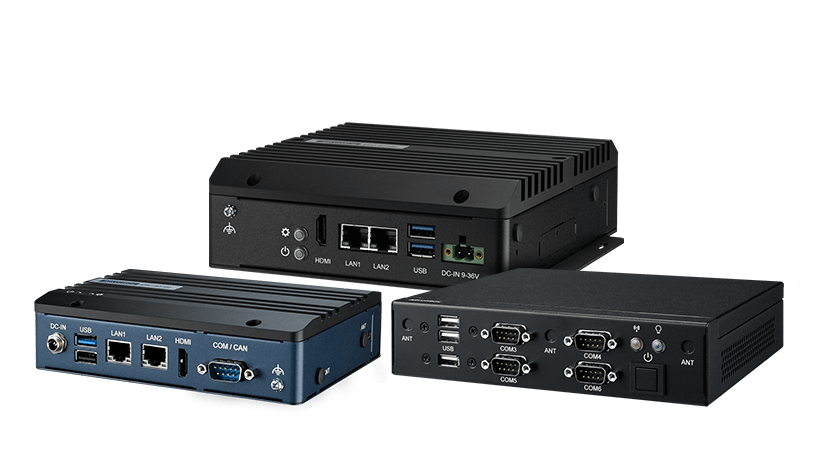
Space constraints on manufacturing equipment and in control cabinets demand computing solutions that deliver full functionality within minimal footprints. Advantech box PC family achieves this through careful thermal engineering that enables fanless operation without performance throttling. These compact systems mount directly to DIN rail, eliminating dedicated enclosure requirements. Wall-mounting variants suit distributed control architectures where local processing reduces network bandwidth and latency. Despite compact dimensions, connectivity remains comprehensive: multiple Gigabit Ethernet ports support network segmentation, USB 3.0 enables high-speed peripherals, and serial interfaces handle legacy equipment. Storage options include industrial-grade SSDs with power-loss protection and wide-temperature SD cards. Operating temperature specifications typically span -40°C to +70°C, addressing applications from cold storage to desert installations.
Technical Architecture
Thermal design accommodates both low-power Atom processors suitable for basic control tasks and higher-TDP Core processors for demanding applications through intelligent heatsink geometry and heat-pipe placement. Power input specifications typically accept 12V or 24V DC with tolerance for voltage transients. Expansion capability varies by model from zero for sealed designs to Mini-PCIe or M.2 slots for wireless cards or storage upgrades. Enclosure materials include aluminium for better heat dissipation or steel for electromagnetic shielding depending on electromagnetic compatibility requirements. Mounting mechanisms beyond DIN rail include VESA patterns for panel mounting or flange brackets for wall installation.
Quality assurance extends beyond component selection into manufacturing processes where automated optical inspection, in-circuit testing, and burn-in cycles validate every assembly. Environmental stress screening subjects products to thermal cycling and vibration exposure revealing latent defects before customer shipment. Statistical process control monitors production parameters maintaining consistency across manufacturing sites. ISO 9001 certification demonstrates systematic quality management while product-specific certifications address industry regulations.
Technical documentation supports system integration through detailed datasheets, user manuals, application notes, and reference designs. CAD files in multiple formats simplify mechanical integration while software drivers and examples accelerate development. Online knowledge bases archive thousands of technical articles, FAQs, and troubleshooting guides. Community forums connect engineers worldwide sharing implementation experiences and solutions.
Application Deployments
Robotic cells mount box PCs for controlling multi-axis motion, managing end-effector functions, and coordinating with vision systems while maintaining compact footprint near robot controllers. Automated guided vehicles integrate box PCs for navigation, obstacle avoidance, and fleet coordination in warehouse and factory environments. Kiosk applications employ box PCs in space-constrained enclosures for interactive displays, payment processing, and printer control. Digital signage networks use box PCs as media players driving multiple displays with scheduled content and remote management. Building automation systems position box PCs throughout facilities for localized HVAC control, lighting management, and access control. Environmental monitoring stations deploy box PCs in remote locations for data logging from weather sensors and pollution analyzers.
Reference installations demonstrate proven capability across diverse industries. Automotive assembly plants worldwide standardize on Advantech computing platforms for production control and quality systems. Pharmaceutical manufacturers achieve validation compliance through reproducible platform behavior and comprehensive documentation. Utilities trust Advantech solutions for critical infrastructure applications where failures affect thousands of customers. Food processors rely on Advantech hygienic-design products meeting stringent contamination prevention standards.
Advantech Differentiation
Market leadership emerges from sustained investment in research, development, and customer success. R&D expenditure exceeding 6% of revenue funds innovation in emerging technologies including AI at the edge, time-sensitive networking, and OPC UA over TSN. Patent portfolio surpassing 2,000 protects intellectual property while licensing arrangements foster industry standards. Participation in industry consortia and standards bodies shapes future technologies benefiting the broader ecosystem.
Global footprint with 96 offices supports local engagement across all continents. Engineering teams collaborate with customers during design-in phases addressing application-specific challenges. Manufacturing facilities positioned strategically reduce lead times and transportation costs. Distribution networks maintain inventory proximity enabling rapid fulfillment. Support infrastructure provides technical assistance through phone, email, web portal, and on-site visits when situations demand.
Lifecycle management policies minimize disruption to long-running projects. Product roadmaps communicate future directions enabling informed platform selection. Obsolescence notifications provide 12-month advance warning with last-time-buy opportunities. Migration programs assist transitions to successor products with compatibility maximization and engineering support. Long-term support contracts extend assistance beyond standard warranty periods.
Common Questions
What warranty coverage applies?
Standard warranty periods range from one to three years depending on product category. Warranty covers manufacturing defects, component failures, and workmanship issues. Extended warranty programs to five years are available for purchase. Warranty terms specify return procedures, replacement turnaround, and advance replacement options for critical applications.
How is technical support accessed?
Support channels include telephone hotlines, email ticketing systems, and web portals for case tracking. Business hours support operates across time zones while 24/7 options serve mission-critical applications. Support tiers address basic configuration questions through complex system debugging. Online knowledge bases provide self-service access to documentation and troubleshooting procedures.
Which certifications are maintained?
Standard product certifications include CE marking for European markets, FCC compliance for North American sales, and UL listing for electrical safety. Industry-specific certifications address IEC 61850-3 for power systems, EN 50155 for railway applications, and DNV for marine installations. Environmental compliance encompasses RoHS for hazardous substance restrictions and REACH for chemical registration.
What are typical lead times?
Stock products typically ship within 2-5 business days from European distribution centers. Custom configurations requiring factory build range from 2-4 weeks depending on complexity. High-volume project orders benefit from dedicated manufacturing slots with negotiated schedules. Expedite services accommodate emergency requirements with premium charges.
How long remain products available?
Minimum availability commitment spans five years from product introduction ensuring stable supply for multi-year projects. End-of-life notifications provide 12-month advance warning enabling last-time-buy planning. Replacement product recommendations accompany discontinuation notices with migration guidance. Extended lifecycle programs serve ultra-long-life requirements in transportation and utility sectors.