
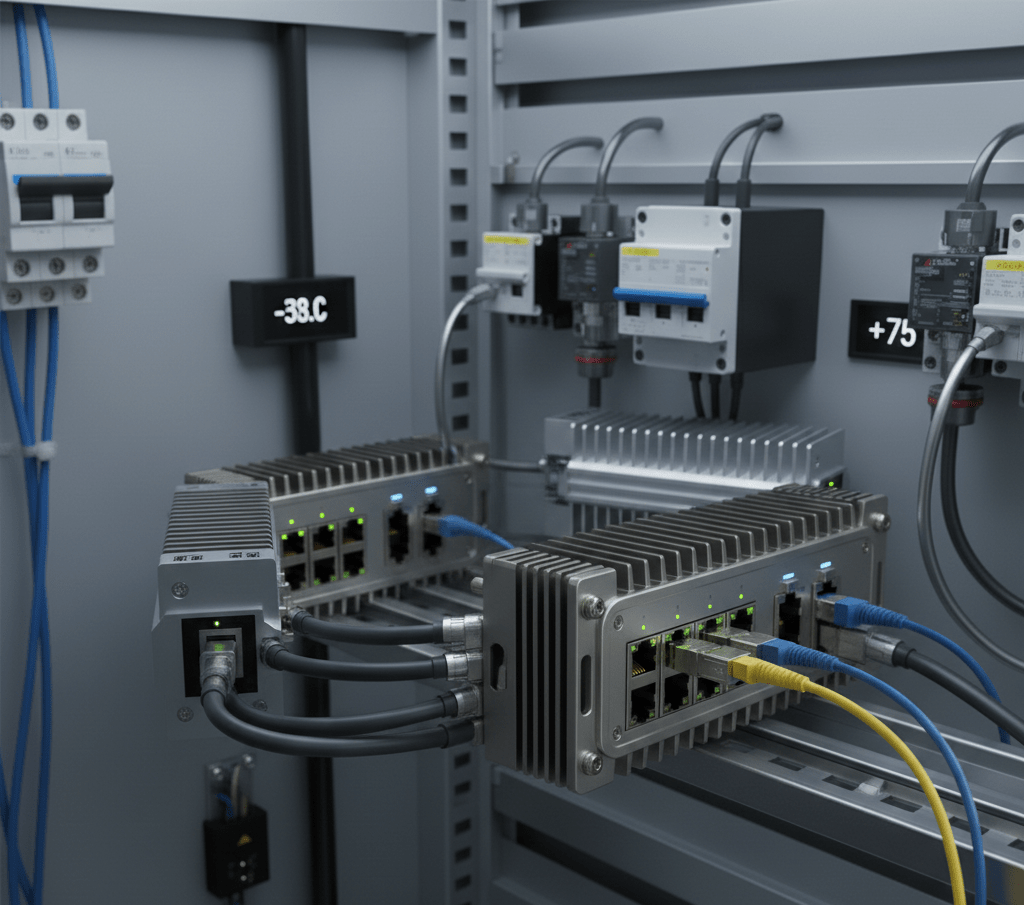
RSTP/MSTP Ring Redundancy Industrial Ethernet Switch
Network failures in industrial environments cause production downtime, safety system interruptions, and data loss costing thousands per minute. Advantech industrial Ethernet switches with RSTP (Rapid Spanning Tree Protocol) and MSTP (Multiple Spanning Tree Protocol) provide redundant network paths with automatic failover, ensuring continuous operation despite cable breaks or equipment failures.
Spanning Tree Protocol Evolution
Original STP (802.1D) prevents network loops but requires 30-50 seconds convergence time during topology changes – unacceptable for industrial control. RSTP (802.1w) reduces convergence to under 1 second through improved algorithms and faster state transitions. MSTP (802.1s) extends RSTP supporting multiple spanning tree instances, enabling VLAN-aware redundancy and load balancing across redundant paths.
Ring Topology Benefits
Industrial networks commonly deploy ring topologies where switches connect in a loop. In normal operation, one link remains blocked preventing loops. When active links fail, the blocked port activates within milliseconds, maintaining network connectivity. Ring protocols specifically optimized for industrial applications achieve <20ms failover times, ensuring PLC communications and SCADA systems experience no disruption.
Dual Ring and Coupled Ring Architectures
Large facilities implement dual rings where independent rings connect through coupling switches. This architecture provides both redundancy within rings and between rings, surviving multiple simultaneous failures. Production areas might operate on separate rings interconnected through core switches, isolating failures while maintaining enterprise-wide connectivity.
FAQ
What’s the difference between RSTP and proprietary ring protocols?
RSTP is an IEEE standard (802.1w) ensuring interoperability between vendors. Proprietary protocols like Siemens MRP or Phoenix Contact HiperRing offer faster recovery (<20ms vs 1-2 seconds) but require all switches from the same manufacturer. Choose based on multi-vendor requirements and recovery time needs.
How many switches can participate in a ring?
RSTP/MSTP theoretically support 250+ switches, but practical limits are 20-50 switches per ring balancing performance and complexity. Larger networks use multiple interconnected rings rather than single massive rings.