
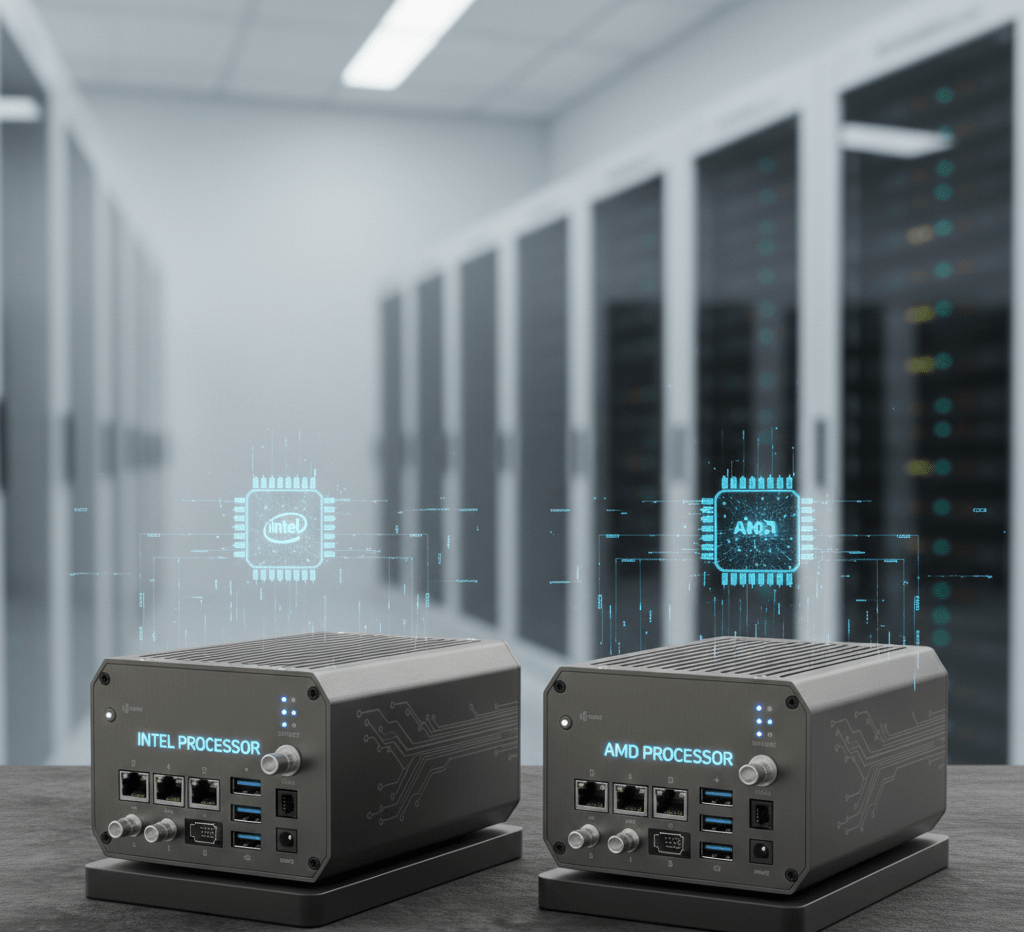
Intel and AMD Processor-Based Embedded Computer Options
Selecting appropriate processors for embedded industrial computers requires balancing performance requirements, power consumption, thermal constraints, and long-term availability. The x86 architecture dominates industrial computing through extensive software compatibility, proven reliability, and continuous performance improvements. Advantech offers embedded computers based on both Intel and AMD processor families, providing flexibility to match specific application requirements while maintaining consistent form factors, I/O configurations, and software ecosystems across processor choices.
Intel has supplied embedded and industrial computing processors for decades through dedicated product lines featuring extended lifecycle support and industrial temperature ratings. The current portfolio spans from power-efficient Atom processors consuming 6-10 watts to high-performance Core i7 processors delivering multi-threaded processing power while maintaining thermal designs suitable for fanless operation. AMD’s Ryzen Embedded and EPYC Embedded families recently entered industrial markets, offering competitive performance-per-watt ratios, integrated graphics capabilities, and pricing alternatives to Intel-based systems while providing similar industrial features including extended availability and temperature ratings.
Intel Processor Options for Industrial Applications
Intel’s embedded processor lineup addresses diverse performance requirements through tiered product families. Atom processors target low-power applications where energy efficiency and thermal management constraints outweigh raw performance needs. Current Atom families like Elkhart Lake deliver quad-core performance with 6-12W TDP, supporting basic HMI displays, protocol conversion, data logging, and simple automation tasks. Passive cooling suffices for most Atom-based systems, enabling completely fanless designs in compact enclosures.
Celeron processors occupy the mid-range performance tier, offering better single-thread performance than Atom while maintaining relatively low power consumption (15-25W TDP). These processors suit applications requiring responsive user interfaces, moderate multitasking, or periodic computational bursts rather than sustained high performance. Edge analytics, machine vision pre-processing, and multi-protocol gateway operations benefit from Celeron’s balanced performance and thermal characteristics. Dual and quad-core configurations provide processing headroom for future application expansion without requiring hardware upgrades.
Core i3/i5/i7 processors deliver desktop-class performance in embedded form factors, supporting demanding applications like real-time video analytics, complex motion control, simultaneous virtual machines, or heavy database operations. TDP ratings from 15W (Core i3/i5 U-series) to 45W (Core i7 H-series) enable performance scaling based on application demands and thermal budgets. Hyper-Threading technology doubles logical processor counts, improving multithreaded workload performance. Turbo Boost dynamically increases clock speeds during light workloads, optimizing performance versus power consumption.
AMD Embedded Processor Alternatives
AMD Ryzen Embedded processors provide competitive alternatives featuring Zen architecture cores delivering strong single-thread and multi-thread performance. The R1000 series targets low-power embedded applications with 12-25W TDP dual-core processors competing with Intel Celeron. R2000 series quad-core processors offer performance comparable to Intel Core i3/i5 while often featuring superior integrated Radeon graphics supporting multiple 4K displays – valuable for digital signage, video walls, and graphics-intensive HMI applications.
AMD’s value proposition extends beyond raw specifications to total cost of ownership considerations. Competitive pricing often positions AMD-based systems 15-20% below equivalent Intel configurations, enabling cost-conscious deployments in price-sensitive markets or large-scale installations where savings multiply across hundreds of units. The integrated graphics performance eliminates discrete GPU requirements for many visualization applications, reducing system complexity and power consumption. AMD’s commitment to socket longevity enables processor upgrades without motherboard replacement, protecting hardware investments.
Performance Benchmarking and Workload Suitability
Synthetic benchmarks provide comparative performance metrics but real-world application behavior depends on workload characteristics. Intel processors typically lead in single-thread performance and memory latency – critical for applications with sequential processing requirements or frequent memory access patterns. AMD processors excel in multi-threaded workloads and integrated graphics performance, benefiting parallel processing applications and graphics-intensive tasks. Power efficiency varies by workload – Intel often demonstrates advantages in idle and light-load scenarios while AMD competitiveness increases under sustained loads.
Industrial automation applications exhibit diverse workload patterns. SCADA systems polling thousands of data points benefit from efficient memory subsystems and I/O processing – areas where Intel maintains slight advantages. Machine vision systems processing multiple camera streams in parallel leverage multi-core performance where AMD competitiveness increases. Edge analytics combining data collection, preprocessing, and machine learning inference show mixed results depending on algorithm characteristics and optimization. Selecting appropriate processors requires understanding specific application demands rather than relying solely on benchmark specifications.
Graphics and Display Capabilities
Modern industrial applications increasingly demand sophisticated graphics for HMI screens, video walls, digital signage, and multi-monitor operator workstations. Integrated graphics evolved from basic 2D acceleration to capable 3D rendering engines supporting multiple 4K displays. Intel UHD Graphics found in Core processors handles typical HMI requirements, dual-monitor setups, and moderate 3D visualization without discrete GPUs. AMD Radeon Graphics integrated in Ryzen Embedded processors often surpasses Intel integrated graphics in raw performance, supporting higher resolution displays, more simultaneous outputs, or graphics-intensive visualizations.
Display interface variety accommodates different monitor types and connection standards. HDMI and DisplayPort digital outputs support modern displays with audio integration. Legacy VGA outputs maintain compatibility with older industrial monitors and HMI panels. Some embedded computers provide eDP interfaces for direct connection to LCD panels in integrated systems. Multiple independent displays enable operator workstations with distinct information on each screen – process overview on one monitor, detailed trends on another, alarm management on a third.
Memory and Storage Subsystems
Both Intel and AMD platforms support DDR4 memory with typical capacities from 4GB to 32GB in embedded industrial computers. Memory speed varies by processor – mainstream configurations operate at 2400-2666 MHz while performance-oriented systems support 3200 MHz. ECC (Error Correcting Code) memory availability depends on processor choice – Intel Xeon-D and some Core variants support ECC while mainstream Core processors do not. AMD Ryzen Embedded broadly supports ECC, providing data integrity advantages for critical applications where memory corruption could cause dangerous control errors or data loss.
Storage primarily employs industrial-grade SSDs ranging from 32GB to 512GB+ capacities. M.2 NVMe interfaces provide high-speed storage performance benefiting database operations, video recording, and applications with intense disk I/O. SATA SSDs suit less demanding applications at lower costs. Industrial SSDs feature extended temperature ratings, power-loss protection, and wear leveling optimized for continuous write operations in data logging applications. Some systems support RAID configurations providing redundancy or performance improvements through striping.
Software Compatibility and Ecosystem
The x86 architecture shared by Intel and AMD processors ensures broad software compatibility. Windows, Linux, and real-time operating systems run on both processor families with minimal differences. Application software, drivers, and development tools generally work identically across Intel and AMD systems. This compatibility simplifies migration between processor vendors based on availability, pricing, or performance requirements without rewriting applications or retraining personnel.
Some specialized applications optimize specifically for Intel or AMD features. Intel’s extensive developer tools, optimization libraries, and technical documentation provide advantages for custom application development. AMD’s open-source graphics drivers benefit Linux deployments. Virtualization features differ slightly – Intel VT-x and AMD-V provide similar capabilities but configuration and management tools may favor one platform. Real-time performance characteristics vary based on latency requirements – mission-critical applications should benchmark both platforms against specific timing requirements.
Long-Term Availability and Roadmap Stability
Industrial equipment lifecycles span 7-15 years, far exceeding typical consumer electronics replacement cycles. Processor obsolescence creates spare parts challenges and forced redesigns. Intel’s embedded roadmap commits to 10+ year availability for industrial processors, ensuring replacement computers remain available throughout equipment lifespans. AMD Ryzen Embedded similarly commits to extended availability though the relatively recent entry into industrial markets means less historical precedent than Intel’s decades-long embedded presence.
Both manufacturers offer migration paths when processor obsolescence becomes unavoidable. Pin-compatible processor families enable upgrades without motherboard redesign. Software compatibility ensures applications run on newer processors without modification. Forward compatibility in industrial computer product lines allows upgrading to newer processor generations within the same chassis and I/O configuration, minimizing integration efforts and maintaining installed base compatibility.
Frequently Asked Questions
Which is better for industrial applications – Intel or AMD processors?
Both offer excellent industrial solutions. Intel provides broader industrial market presence, extensive embedded roadmap history, and typically leads single-thread performance. AMD offers competitive pricing, superior integrated graphics, and strong multi-thread performance. Choose based on specific application requirements, workload characteristics, and total cost considerations rather than brand preference.
Can I switch between Intel and AMD without software changes?
Generally yes – x86 architecture compatibility means Windows and Linux applications run on both platforms without modification. Device drivers and BIOS/UEFI differ but applications remain compatible. Performance optimization and hardware-specific features may require tuning but core functionality transfers seamlessly.
What about ECC memory support?
AMD Ryzen Embedded processors broadly support ECC memory, providing error detection and correction valuable for critical applications. Intel mainstream Core processors don’t support ECC, though Xeon-D embedded processors do. Applications requiring ECC should verify processor support or select platforms specifically offering this capability.
Which processor family provides better graphics performance?
AMD Radeon Graphics integrated in Ryzen Embedded typically surpasses Intel UHD Graphics in 3D performance, supporting more displays at higher resolutions. Intel graphics suits typical HMI and dual-monitor applications. Graphics-intensive applications like video walls or 3D visualization benefit from AMD’s superior integrated graphics or both platforms can use discrete GPUs for maximum performance.
How long will these processors remain available?
Both Intel and AMD commit to 10+ year availability for embedded processors. Industrial product lines often extend beyond this through design-in support, enabling long-term spare parts availability. Selecting processors with extended lifecycle guarantees protects long-term industrial equipment investments.
Do fanless systems work with high-performance processors?
Yes, but with appropriate thermal design. Lower TDP variants (15-25W) easily suit fanless operation. Higher performance 35-45W processors require larger chassis or more sophisticated thermal designs but remain feasible in fanless configurations. Applications requiring sustained maximum performance may need active cooling or should select lower TDP processors.
What about power consumption differences?
Power consumption varies by processor model and workload rather than brand. Both Intel and AMD offer low-power variants (6-15W TDP) for energy-critical applications and higher-performance versions (35-45W TDP) for demanding workloads. Compare specific processor models against application requirements rather than making generalized assumptions about brand efficiency.
Are there security differences between Intel and AMD processors?
Both platforms implement hardware security features including secure boot, encrypted memory, and trusted execution environments. Intel offers technologies like Intel TXT and SGX, while AMD provides AMD Secure Processor and SEV. Most industrial applications find both platforms adequately secure with proper configuration and security practices.