
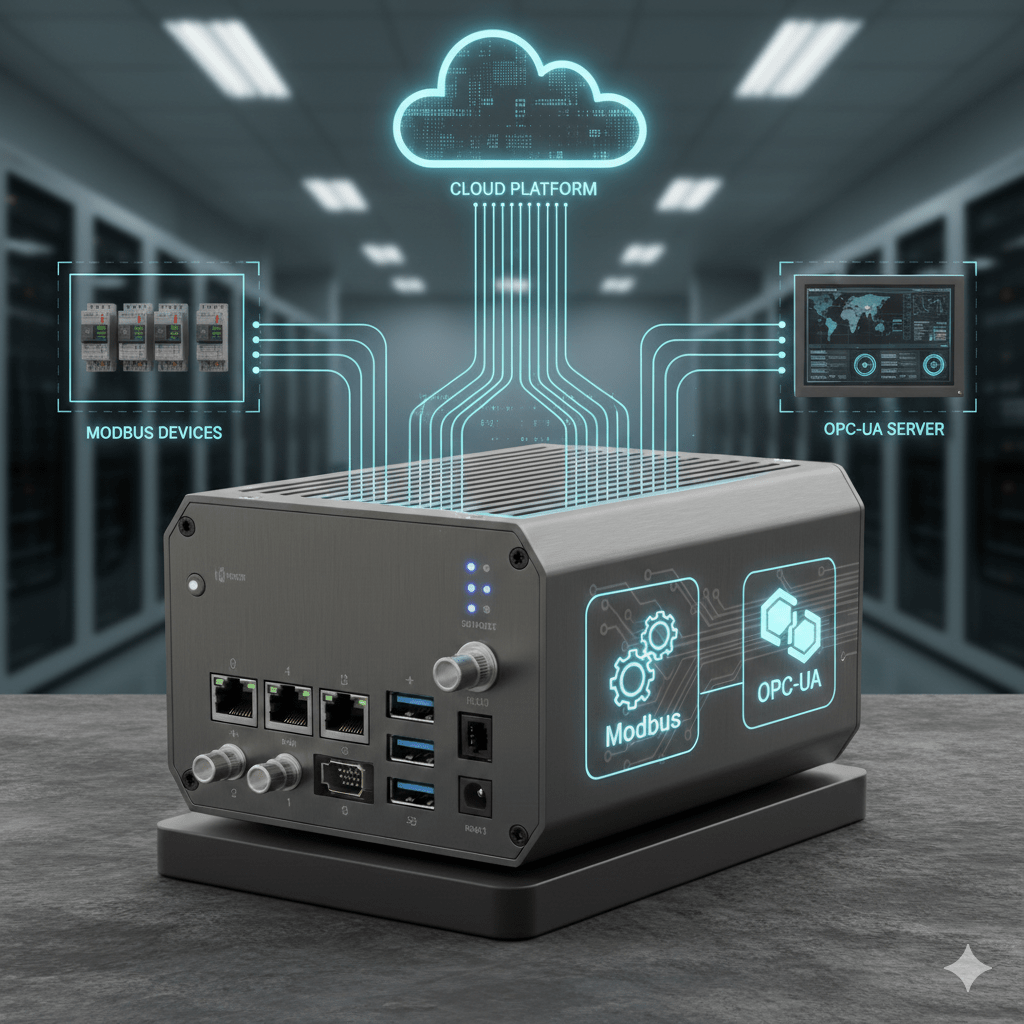
Modbus and OPC-UA Protocol Supported IoT Gateway Models
Industrial facilities operate with equipment from dozens of manufacturers, each implementing different communication protocols. A typical production line might include legacy PLCs speaking Modbus RTU over serial connections, modern controllers supporting OPC UA over Ethernet, building automation systems using BACnet, and newer IoT sensors publishing data via MQTT. Integrating these disparate systems traditionally required multiple specialized converters, custom software development, and complex network architectures. Advantech IoT gateways eliminate this complexity by providing native support for the most widely deployed industrial protocols, with particular strength in Modbus and OPC UA implementations that meet the demanding requirements of Industry 4.0 deployments.
The UNO-1372G exemplifies Advantech’s approach to protocol flexibility in a compact form factor. This DIN-rail mountable gateway features four configurable serial ports that can operate as Modbus RTU master or slave, polling up to 100 devices at baud rates from 2400 to 115200 bps. The serial interfaces support automatic RS-232/422/485 detection with optical isolation preventing ground loops that plague industrial serial networks. Simultaneously, the dual Gigabit Ethernet ports handle Modbus TCP communications, with the gateway able to bridge between serial Modbus RTU devices and Ethernet-based Modbus TCP systems transparently. This protocol conversion occurs in real-time with sub-millisecond latency, ensuring deterministic performance for time-sensitive control applications.
OPC UA Server and Client Capabilities
OPC Unified Architecture represents the modern standard for industrial data exchange, replacing the older OPC Classic specifications that relied on Windows-specific DCOM technology. The UNO-2372G implements a full-featured OPC UA server compliant with the OPC Foundation’s specifications, supporting both binary and JSON encodings over TCP transport. Security features include certificate-based authentication using X.509 digital certificates, encrypted communications via TLS 1.2 or higher, and granular access control defining read/write permissions at the node level. The gateway can expose up to 10,000 data points through its OPC UA server, organizing them in hierarchical address spaces that mirror the physical equipment topology or follow ISA-95 plant information models.
As an OPC UA client, the UNO-2372G connects to external OPC UA servers, subscribing to data changes rather than polling. This publish-subscribe model reduces network traffic and CPU load compared to traditional polling architectures. The gateway supports OPC UA browsing, allowing runtime discovery of available data points from connected servers without preconfiguration. Alarms and events flow through OPC UA alarm conditioning, with the gateway able to acknowledge alarms bidirectionally. Historical data access via OPC UA HDA enables retrieval of timestamped values from connected historians.
Advanced Protocol Translation Features
The UNO-2484G provides the most extensive protocol conversion capabilities in Advantech’s gateway lineup. With eight serial ports and four Ethernet interfaces, this platform handles complex scenarios like aggregating data from 200+ Modbus RTU field devices, normalizing the data into a unified namespace, and exposing it through both OPC UA and MQTT interfaces simultaneously. Each protocol operates independently – SCADA systems can read data via OPC UA while cloud analytics platforms consume the same data via MQTT, all without conflicts or performance degradation.
The gateway’s protocol mapping engine allows sophisticated data transformations beyond simple one-to-one conversions. Modbus registers can be scaled, offset, and combined mathematically before publishing to OPC UA. For example, two 16-bit Modbus registers containing high and low words of a 32-bit floating-point value are automatically combined into proper IEEE 754 format. Unit conversions apply during translation – temperature readings in Celsius from Modbus devices can appear as Fahrenheit in OPC UA. Bitwise operations extract individual Boolean values from packed Modbus coils or registers, presenting them as separate OPC UA Boolean nodes.
ADAM-3600 Series I/O and Protocol Gateway
The ADAM-3600 combines distributed I/O capabilities with protocol gateway functions in a single rugged package. This device directly acquires analog inputs, digital I/O, and counter/pulse data from field sensors, eliminating the need for separate remote I/O modules. The onboard processor runs both Modbus RTU/TCP server and OPC UA server stacks, making local I/O data available through both protocols simultaneously. This dual-protocol approach suits retrofits where existing Modbus SCADA systems must coexist with newer OPC UA-based MES or cloud platforms.
The ADAM-3600’s Ethernet ports support Modbus TCP with up to 32 concurrent client connections. A built-in web server provides browser-based configuration without requiring specialized software installation. Real-time trending displays allow quick verification of I/O values and communication status during commissioning. Diagnostic pages show detailed Modbus frame counts, error rates, and last poll times for each configured device. OPC UA security can be disabled for initial testing, then progressively hardened by enabling username/password authentication, certificate validation, and encrypted communications as the deployment matures.
Protocol Performance and Determinism
Industrial control applications require predictable timing, not just average throughput. All Advantech gateways implement deterministic polling schedules where each Modbus device or OPC UA subscription receives attention at precisely defined intervals. The UNO-2372G can poll 100 Modbus devices every 100ms with less than 1ms jitter, crucial for closed-loop control systems. If network delays or device timeouts occur, the gateway’s watchdog circuits detect the condition, log detailed diagnostics, and maintain polling other devices rather than blocking the entire scan cycle.
OPC UA subscriptions support configurable publishing intervals from 10ms to hours, with separate sampling intervals per data point. The gateways implement OPC UA’s deadband filtering – analog values only publish when they change by more than a defined threshold, dramatically reducing unnecessary network traffic for slowly changing process variables. Timestamping occurs at the moment of data acquisition, not during subsequent protocol translations, preserving temporal accuracy even when buffering data during network outages.
Integration with Common Industrial Equipment
Advantech gateways ship with pre-configured device drivers for hundreds of popular industrial devices. Modbus register maps for common power meters, temperature controllers, VFDs, and flow meters come pre-loaded, allowing drag-and-drop configuration rather than manual register mapping. For Siemens S7 PLCs, Allen-Bradley CompactLogix, Schneider Modicon, and Mitsubishi FX series controllers, the gateways support both Modbus and native protocols, providing flexibility based on existing SCADA infrastructure.
OPC UA companion specifications for specific industries – PackML for packaging machinery, AutomationML for discrete manufacturing, Sercos for motion control – are supported through optional modules. These specifications provide standardized information models ensuring consistent representation of machine capabilities, status, and commands across different vendors’ equipment. A robot from one manufacturer and a conveyor from another both expose position, speed, and mode data through identical OPC UA structures, simplifying application development.
Configuration and Management Tools
Advantech’s WebAccess/DMP platform provides centralized management for gateway fleets. Administrators define Modbus polling configurations, OPC UA address spaces, and protocol mappings through web-based graphical interfaces. Configurations can be saved as templates and deployed to multiple gateways, ensuring consistency across production lines or facilities. The platform monitors gateway health, tracking metrics like CPU utilization, memory usage, Modbus error rates, and OPC UA session counts. Automated alerts notify administrators of conditions requiring attention – rising Modbus timeouts might indicate deteriorating field wiring, while OPC UA certificate expiration warnings allow proactive renewal.
For edge computing scenarios, the gateways support containerized applications through Docker. Custom protocol handlers, data preprocessing algorithms, or machine learning inference can run alongside the standard Modbus and OPC UA stacks. Container orchestration allows zero-downtime updates – a new version of a custom protocol converter deploys to a staging container, undergoes testing, then seamlessly transitions to production while the old version terminates. This enables continuous improvement of automation infrastructure without process interruptions.
Real-World Deployment Example
A European automotive component manufacturer faced protocol integration challenges when deploying a new MES system. The shop floor contained 40 CNC machines with Modbus RTU interfaces, 25 robotic welding cells supporting OPC UA, and 30 manual assembly stations with simple digital I/O. The existing SCADA system required Modbus TCP connectivity. The manufacturer deployed 12 UNO-2484G gateways throughout the facility. Each gateway aggregated data from nearby equipment via Modbus RTU serial connections and OPC UA Ethernet connections. The gateways then provided three simultaneous data streams: Modbus TCP to the legacy SCADA system, OPC UA to the new MES platform, and MQTT to a cloud-based analytics service. The project completed in six weeks versus the 14-week estimate for custom integration code, with ongoing maintenance reduced as Advantech handles protocol stack updates.
Frequently Asked Questions
What Modbus functions are supported by Advantech gateways?
Advantech gateways support all standard Modbus function codes including Read Coils (01), Read Discrete Inputs (02), Read Holding Registers (03), Read Input Registers (04), Write Single Coil (05), Write Single Register (06), Write Multiple Coils (15), and Write Multiple Registers (16). Extended function codes for diagnostics and file transfers are also supported depending on the model.
Can these gateways convert between Modbus RTU and Modbus TCP?
Yes, all models provide transparent bidirectional conversion between Modbus RTU serial and Modbus TCP Ethernet. Modbus RTU devices on serial ports appear as Modbus TCP slaves on Ethernet, and vice versa. The gateway handles all protocol framing, CRC verification, and timeout management automatically.
Is the OPC UA implementation certified by the OPC Foundation?
Yes, Advantech’s OPC UA server implementation is certified compliant with OPC UA specifications. The gateways support the OPC UA Binary encoding, security policies including Basic256Sha256 and Aes128_Sha256_RsaOaep, and user authentication via username/password or X.509 certificates.
How many OPC UA clients can connect simultaneously?
The UNO-1372G supports up to 10 concurrent OPC UA client sessions, the UNO-2372G supports 25 sessions, and the UNO-2484G supports 50 sessions. Each session can maintain multiple subscriptions with hundreds to thousands of monitored items depending on publishing intervals and data change rates.
Can the gateways handle Modbus devices with custom register mappings?
Absolutely. While pre-configured drivers simplify setup for common devices, the gateways provide flexible manual register mapping. Users define which Modbus registers to poll, their data types (16-bit integer, 32-bit float, etc.), polling frequencies, and how to scale/transform the raw values. These custom mappings can be exported and reused across multiple gateway deployments.
What happens if Modbus devices don’t respond?
The gateways implement configurable retry logic with exponential backoff. If a Modbus device fails to respond within the timeout period (typically 500ms to 5 seconds), the gateway retries up to 3 times before marking that device offline. The gateway continues polling other devices and logs the timeout event. When the offline device responds again, the gateway automatically restores normal operation and logs the recovery.
Do these gateways support Modbus over cellular connections?
Models with integrated cellular modems like the ICR-3200 support Modbus TCP over LTE networks. However, Modbus RTU is serial-only and cannot run directly over cellular. The gateway can aggregate Modbus RTU data locally, then republish it via Modbus TCP or OPC UA over the cellular connection to remote systems.
Can I browse available OPC UA data without knowing the address space structure?
Yes, standard OPC UA browsing allows clients to discover the gateway’s address space structure at runtime. The gateway organizes data hierarchically – for example, by machine, then subsystem, then individual data points. OPC UA clients can programmatically traverse this structure to find available data without preconfigured node IDs, useful for generic HMI or analytics applications.