
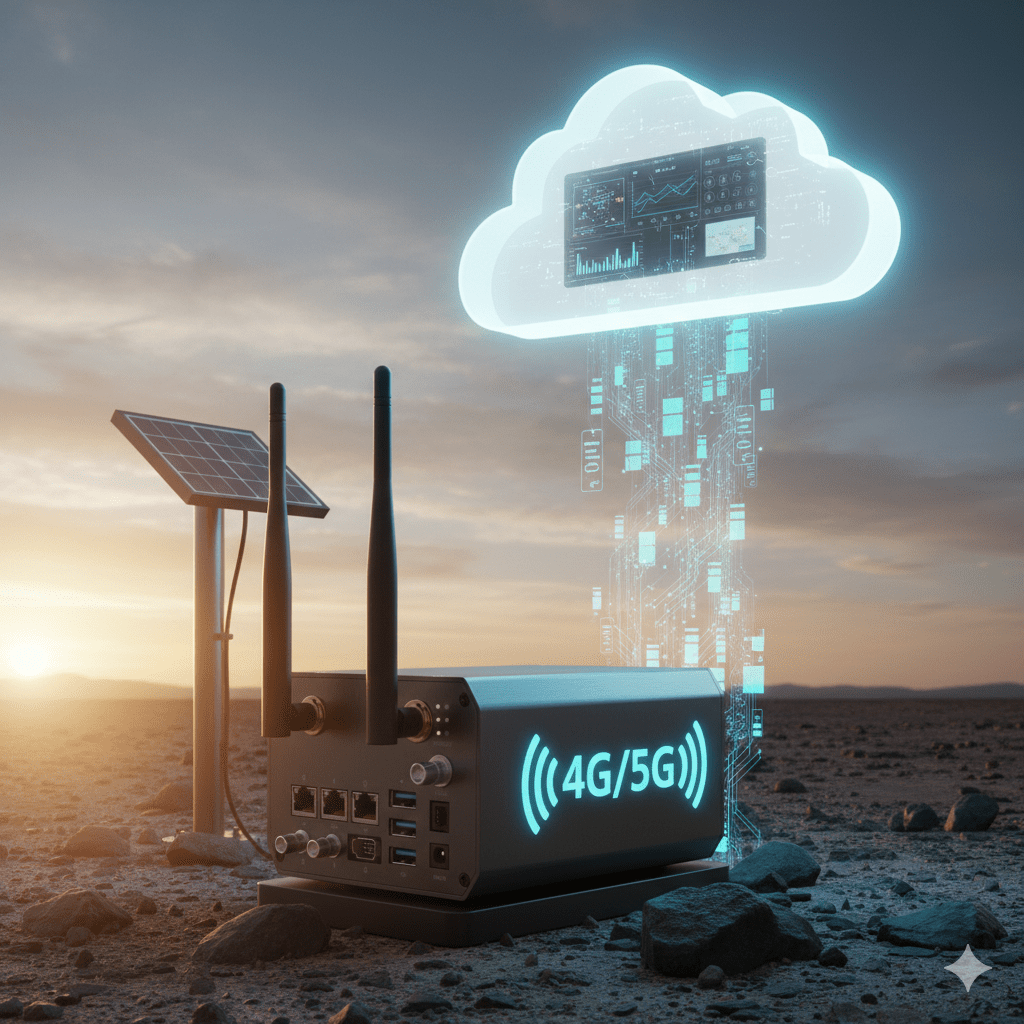
4G/5G Cellular IoT Gateway for Remote Monitoring Solutions
Industrial assets increasingly operate in distributed locations where traditional wired network infrastructure is unavailable, impractical, or prohibitively expensive. Remote pumping stations, distributed renewable energy installations, agricultural irrigation systems, construction sites, and mobile equipment require reliable connectivity without the delays and costs of trenching fiber or running copper cables. Advantech cellular IoT gateways provide industrial-grade wireless connectivity, combining robust LTE and 5G modems with the protocol conversion, edge computing, and security features necessary for mission-critical remote monitoring applications.
The ICR-3200 series represents Advantech’s most widely deployed cellular gateway platform. Built around LTE Cat.4 cellular modems, these devices deliver download speeds up to 150 Mbps and upload speeds up to 50 Mbps – more than adequate for most industrial IoT applications that transmit sensor readings, alarms, and operational data rather than video streams. The integrated modem supports global LTE frequency bands including Band 1-5, 7-8, 12-13, 17-20, 25-26, 28-29, 30, 41, and 66, enabling worldwide deployment without hardware changes. Carrier certification from major operators including Verizon, AT&T, T-Mobile, Vodafone, and China Mobile ensures compatibility with existing industrial cellular data plans.
Dual SIM Redundancy and Failover
Network availability proves critical for remote monitoring applications where connectivity loss might delay detection of equipment failures, environmental hazards, or security breaches. All ICR series gateways feature dual SIM slots supporting automatic failover between cellular carriers. In the default configuration, the gateway monitors the primary SIM’s signal strength, registration status, and data throughput continuously. If signal drops below -105 dBm, registration fails after three attempts, or data transfer stalls for more than 60 seconds, the gateway automatically switches to the backup SIM within 10-15 seconds. Custom failover policies allow switching based on data usage limits, time schedules, or manual override commands.
The dual SIM architecture also enables load balancing scenarios where the gateway alternates between carriers to distribute monthly data consumption, preventing overage charges on either plan. For international deployments, the primary SIM might provide connectivity in the home country while the backup SIM roams in adjacent countries, eliminating service interruptions at borders. The ICR-1600 compact model, measuring just 105mm wide, fits the same dual SIM capability into control cabinets with limited space, making it ideal for retrofitting cellular connectivity to existing installations.
Extended Temperature and Environmental Ruggedness
Remote industrial sites expose equipment to environmental extremes rarely encountered in climate-controlled data centers. The ICR-4551 operates across a temperature range from -40°C to +75°C without derating, verified through thermal cycling tests exceeding 1000 cycles. This extended range suits outdoor installations in extreme climates – desert solar farms experiencing 60°C+ ambient temperatures, arctic pipeline monitoring stations at -40°C, and mobile equipment where direct sunlight creates internal enclosure temperatures exceeding 70°C. Conformal coating on circuit boards protects against humidity, condensation, salt spray, and airborne contaminants common in coastal, agricultural, and industrial environments.
The ruggedized metal chassis provides IP30 dust protection as standard, with IP40 and IP65 variants available for harsher conditions. Electromagnetic interference shielding protects against industrial equipment generating high-frequency noise – VFDs, welding equipment, radio transmitters, and switching power supplies. EN50121-4 railway certification on the ICR-2631 ensures reliable operation in rolling stock applications subject to severe vibration, electromagnetic interference from traction systems, and rapid temperature changes during tunnel passages. Vibration testing at 5G across 5-500 Hz confirms mechanical stability even when mounted on machinery or vehicles.
Flexible Connectivity and Protocol Support
Industrial equipment rarely speaks IP natively. The ICR-3200 bridges serial devices to cellular networks, offering two Ethernet ports (10/100/1000 Mbps) and one or two serial ports configurable as RS-232, RS-422, or RS-485 with automatic signal detection. This flexibility allows connection to legacy RTUs, PLCs, and instruments using Modbus RTU, DNP3, or proprietary serial protocols. The gateway handles protocol conversion, presenting serial device data via Modbus TCP, OPC UA, or MQTT over the cellular connection to remote SCADA servers or cloud platforms.
Transparent serial tunneling provides a virtual COM port on remote computers, making serial devices appear locally connected despite cellular network separation. This mode suits applications requiring bidirectional communication – uploading new PLC programs, downloading firmware updates to field instruments, or accessing equipment diagnostic menus. SSL/TLS encryption protects the serial data tunnel from eavesdropping, while certificate authentication prevents unauthorized access. Digital I/O on some models enables direct monitoring of equipment status without intermediate PLCs – door contacts, flow switches, pressure transducers with 4-20mA outputs connect directly to the gateway.
Data Management and Bandwidth Optimization
Cellular data plans charge by the gigabyte, making bandwidth efficiency important for controlling operational costs across large deployments. The gateways implement multiple data reduction strategies. Store-and-forward buffering accumulates data locally during scheduled polling intervals, then transmits batched data every 5-15 minutes rather than maintaining persistent connections. This approach reduces cellular network overhead and extends battery life for solar-powered remote installations. The buffer can hold 100,000 data points, ensuring no information loss even during extended outages.
Compression algorithms reduce payload sizes by 60-80% for text-based protocols like Modbus ASCII or MQTT JSON messages. Change-of-state reporting only transmits data when values exceed configured deadbands, eliminating redundant updates for stable process variables. Adaptive sampling adjusts poll frequencies based on value volatility – rapidly changing temperatures during equipment startup might poll every second, slowing to once per minute during steady-state operation. These optimizations commonly reduce monthly cellular data consumption to 50-200 MB per site versus 500-1000 MB for naive continuous streaming.
Security Architecture for Remote Access
Connecting industrial control systems to public cellular networks creates attack vectors that didn’t exist with isolated private networks. The ICR series implements multi-layered security following IEC 62443 industrial cybersecurity standards. Built-in firewalls filter incoming connections by IP address, port, and protocol, creating whitelist-based access control. Only SCADA servers at specific public IP addresses can initiate connections to field devices. VPN client support establishes encrypted tunnels to central VPN concentrators, providing defense-in-depth where cellular traffic traverses public internet infrastructure before reaching private SCADA networks.
Certificate-based authentication using X.509 digital certificates provides stronger security than username/password schemes vulnerable to brute force attacks. The gateway validates server certificates before establishing connections, preventing man-in-the-middle attacks. Secure boot verifies firmware signatures during power-up, rejecting unauthorized firmware modifications that might introduce backdoors. An integrated Trusted Platform Module (TPM 2.0) on enterprise models provides hardware-based cryptographic key storage resistant to software extraction attempts. Regular security updates address newly discovered vulnerabilities, with Advantech maintaining support throughout each product’s 7-10 year lifecycle.
GPS and Location Services
Many remote monitoring applications benefit from geographic context – knowing where alarms originate, tracking mobile assets, or correlating environmental conditions with location. Select ICR models integrate GPS receivers providing position accuracy within 2-5 meters under clear sky conditions. Timestamped location data appends to transmitted telemetry, enabling map-based visualization in SCADA systems and cloud platforms. Geofencing triggers alerts when mobile equipment leaves designated operational areas, useful for theft prevention and regulatory compliance in applications like construction equipment or waste collection vehicles.
For stationary installations, one-time GPS acquisition during commissioning records installation coordinates, then the GPS receiver powers down to conserve energy. The stored location automatically tags all subsequent data transmissions. Cell tower triangulation provides backup positioning when GPS signals are unavailable – inside buildings, under bridges, or in urban canyons where multipath interference degrades GPS accuracy. While less precise than GPS (100-1000 meter accuracy), cell tower positioning still provides useful geographic context at city/region scale.
Power Management and Alternative Energy Integration
Remote sites often lack grid power, relying on solar panels, wind turbines, batteries, or generators. The gateways accept wide voltage inputs from 9V to 48V DC, compatible with 12V and 24V battery banks common in off-grid installations. Reverse polarity protection prevents damage from incorrect wiring, while surge protection guards against transients from lightning strikes or generator switching. Power consumption varies by model – the ICR-1600 draws 3-5 watts typical, allowing continuous operation from a 20W solar panel with small battery backup in most climates. The larger ICR-3200 consumes 8-12 watts, requiring larger solar arrays or primary power with battery backup.
Intelligent power management reduces consumption during idle periods. After transmitting scheduled data updates, the gateway enters low-power sleep mode where the cellular modem and Ethernet ports power down, leaving only a watchdog timer running. Wake events include scheduled transmission times, incoming SMS messages, or digital input state changes. For solar-powered sites, battery voltage monitoring prevents deep discharge damage – if voltage drops below 11V, the gateway reduces transmission frequency or enters hibernation until solar charging restores adequate reserves. This automatic load shedding ensures critical alarms still transmit even during extended cloudy weather.
Real-World Application: Water Utility Monitoring
A municipal water utility manages 240 remote pumping stations across 1200 square kilometers of service area. Before cellular gateway deployment, operators drove to each site weekly for manual readings and maintenance checks, requiring 15 full-time employees. Intermittent pump failures went undetected between visits, causing service disruptions and regulatory violations. The utility deployed ICR-3200 gateways at all sites, connecting to existing PLC serial ports. The gateways transmit pump run hours, flow rates, tank levels, and equipment alarms to a central SCADA system every 15 minutes via LTE. SMS alerts notify on-call technicians of high-priority alarms like pump failures or low water pressure. The project eliminated routine site visits, reduced staffing to 8 employees, decreased emergency response times from hours to 20-30 minutes, and prevented $400,000 in annual regulatory fines through early problem detection.
Frequently Asked Questions
What cellular networks do these gateways support?
Advantech cellular gateways support LTE (4G) networks with Cat.4 or Cat.6 modems, and select models offer 5G NR connectivity. They are carrier-agnostic and work with any cellular provider offering standard data plans. The modems support global frequency bands, enabling international deployments without hardware changes.
How does dual SIM failover work?
The gateway continuously monitors the active SIM’s signal strength and connection status. If connectivity fails or degrades below threshold, it automatically switches to the backup SIM within 10-15 seconds. Switching occurs based on signal strength, registration failures, data throughput, or manual commands. Users can configure primary/backup priority or load balancing between SIMs.
What is the typical monthly cellular data consumption?
Data usage varies greatly by application. A typical remote monitoring site polling 50-100 data points every 15 minutes with compression enabled uses 50-200 MB monthly. High-frequency polling, video surveillance, or continuous VPN connections can consume several gigabytes monthly. The gateways include data usage monitoring and alerting to prevent overage charges.
Can these gateways work in areas with poor cellular coverage?
Yes, the gateways implement advanced error correction, automatic retry logic, and aggressive antenna gain optimization for marginal signal conditions. External antennas with higher gain (5-9 dBi) can be added for challenging RF environments. The dual SIM capability allows using carriers with better coverage in specific locations. Minimum usable signal is approximately -110 dBm.
How are cellular gateways secured against cyber attacks?
Security features include stateful firewall with IP whitelisting, VPN client support (OpenVPN, IPsec, L2TP), certificate-based authentication, encrypted communications (TLS/SSL), secure boot, intrusion detection, and regular firmware security updates. The gateways follow IEC 62443 industrial cybersecurity standards for defense-in-depth protection.
What happens during cellular network outages?
The gateways buffer up to 100,000 data points locally during network outages. When connectivity restores, buffered data automatically uploads to maintain historical continuity. Dual SIM failover provides redundancy if one carrier experiences outages. Critical alarms can be sent via SMS to backup notification systems.
Do I need special SIM cards for industrial IoT applications?
Standard cellular data SIM cards work fine for most applications. Some carriers offer industrial IoT specific plans with features like static IP addresses, lower latency routing, guaranteed bandwidth, and extended coverage through roaming agreements. M2M/IoT plans often provide better value for low-bandwidth, high-connection-count deployments than consumer data plans.
How long do these gateways typically operate before requiring maintenance?
With no moving parts (fanless design) and industrial-grade components, the gateways typically operate 5-7 years without maintenance. Battery-backed real-time clocks maintain configuration during power outages. Flash memory with wear leveling ensures 10+ year data retention. Firmware updates via cellular connection extend functionality and security without site visits.